Fairview Historical Society Articles Archives
Home – Articles – Videos – eBooks & PDFs – Local Authors – Sponsors – Contact
Submitted By: Devonna Edwards
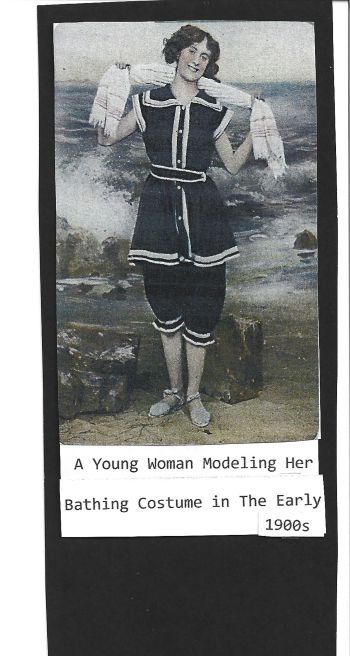
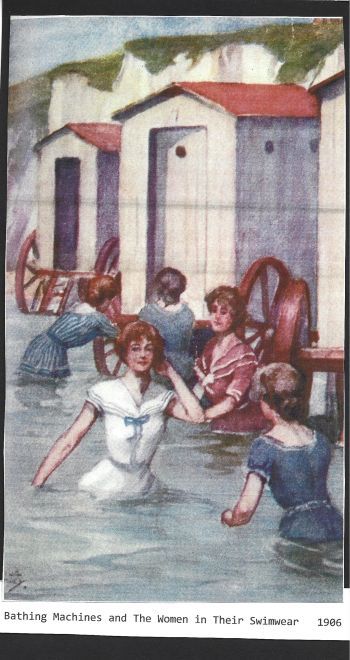
Years ago people going to the beach wore ‘bizarre’ swimming costumes according to today standards. At the turn of the century women generally wore knee length wool dresses or pantaloons along with wool stocking to go swimming. The swimming garment was very cumbersome and designed with modesty in mind. Women were required to change into their swimsuits in a Bathing Machine.
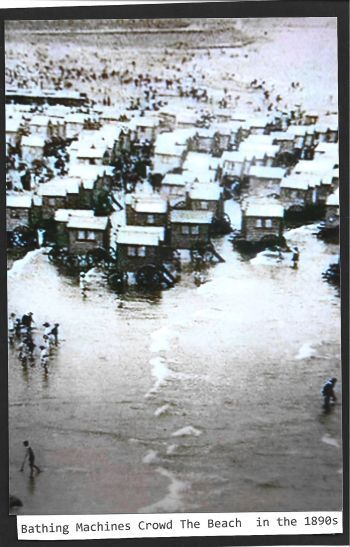
Bathing Machines or Bathing Carriages were invented in the 1700s in England and were designed to protect the modesty of female bathers. Male and female bathing (swimming) were segregated by law until 1901, prior to that it was unacceptable for men or women to see each other in their swimming costume. Women were required to remain fully dressed until they entered a Bathing Carriage then they changed
into their bathing costume.
The Bathing Machine or Carriage was described as being made of wood or canvas and mounted on four large wide wheels. The cabin was 6 feet high and 8 feet wide. The machine had a ladder for entry and door at each end. It was driven by a horse or a pair of horses with a driver. When the female enters the cabin by the ‘back’ door, she changed into her swim suit and than the horse dragged the machine into the sea. She entered the water in privacy from the ‘front door’ under a canvas awning which is let down to the surface of the water, so she could descend from the machine by a few steps without being seen in her beach wear. At times a strong female person called a ‘dipper’ was on hand to escort the bather into the sea and when finished her swim the ‘dipper’ pulled her out. This contraptions allowed her to swim in the sea with the utmost modesty. Bathing Machines were used until the late 1890s when they became permanently placed on the beaches but by 1914 they disappeared from the beaches.
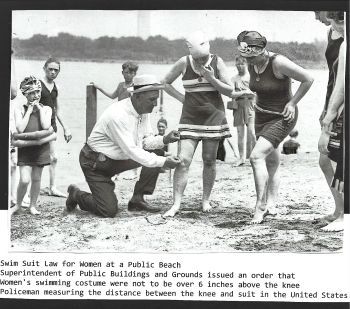
By the 1920s Swim wear was becoming more form fitting exposing arms and more of the legs. Women on the beach had to be careful of the length because Beach Patrolmen could stop them to measure their swim-suits if they thought they were too short. The law was that suits not be over 6 inches above the knee.
Public Baths in the Halifax Era: Russell Street- Located in the Richmond area of Northern Halifax.
In 1898 there was a public bath at the foot of the street where many people came to swim. Every person that came to swim there each day was required to sign their name in a Bathing Register book.
Fairview Cove Bathing Baths– Located on the Bedford Basin.
Once a popular bathing area containing a Bathing Pavilion where swimmers changed in and out of their swimwear.
The popular beach also had a Bathing Register in the 1930s for swimmers to sign in.
The Cove also had a lifeguard on duty every day during the summer. Bert Cooper was a popular lifeguard there and
saved many lives. The Fairview Cove Container Terminal occupies the site today.
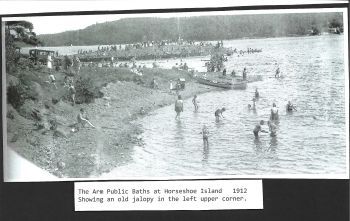
Horseshoe Island– Located on the Northwest Arm and accessible by Quinpool Road.
A new Public Bathing House opened at Horseshoe Island in 1927 which was vastly superior to the old bathing house. Bathing towels and suits were available at a small price. Concrete steps led from the road down to the bathing area which made it easier for people to descend
the high hill.
Enormous crowds flocked to the popular swimming beach every day when the weather was suitable. In 1927 they were said to have as many as 2000 people on a daily basis. It was beautiful with green grass surrounding the area where swimmers could lay on their blankets and soak up the sun after a refreshing swim. A stone wall formed a circle around the beach with a few concrete steps leading into the water and a wooden diving raft floated near the shore. A large Bath house was located there with changing rooms for 50 men on one side and rooms for 50 women on the other side.
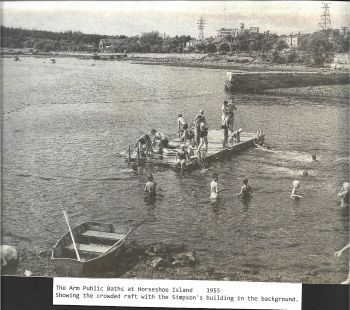
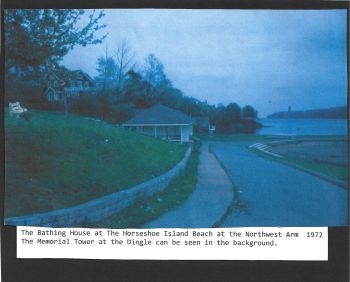
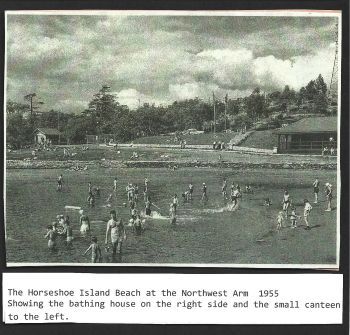
A small canteen stood on the hill just off the driveway leading from Quinpool Road. In 1936 a house-boat or shack which was built on a small scow was towed around the Arm and used as a floating canteen, but by 1938 it was a menace and abandoned on the Arm waters. It was then described in a Halifax newspaper as a potential danger to children, a menace to navigation and a despoliation to the beauties of the Arm. At that point it was resting on the beach just above the Public Baths and residents were worried that children may push it off and use it as diving raft.
In 1936 the Northwest Arm water was getting very polluted. A water test showed the actual presence of the deadly Bacillus Coli. Thirteen year old Marjorie Osborne (one of the thousands of Halifax children who went swimming every day) got very ill and died. Her illness was blamed on the polluted seawater due to hundreds of gallons of sewage poured into the water a hundred yards from the popular bathing spot.
The Dingle Bathing Beach
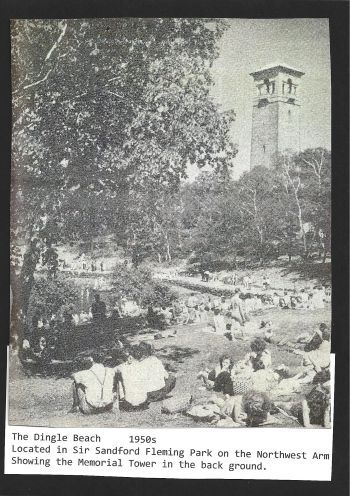
Located in Fleming Park on the Northwest Arm was another favorite bathing beach. The beach was surrounded by lovely rolling hills with many trees that supplied needed relief from the hot sun. Not far from the sandy beach a brook snaked down the hill into the sea water, all the while making a lovely laughing sound. Hundreds of people flocked there daily for fun in the sun. They also had a popular canteen in the 1930s and one was still there well into the 1960s. They also had a Public Bath Changing House that was close to the canteen. The Dingle Tower stood
nearby and was crowded with spectators, either climbing the long winding stairs to the top or sitting on the two enormous lions guarding the front entrance.
Black Rock Beach
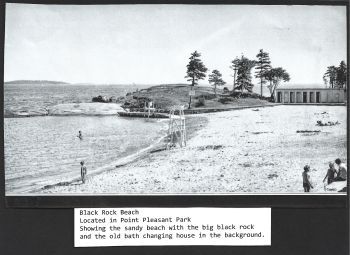
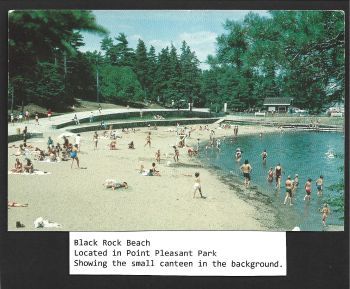
Located in Point Pleasant Park was also a well-known bathing spot. It also provided a life guard in 1952 and a Public Bath Changing House in 1953. A paradise in the center of the city, the small beach provided an enjoyable day especially for the children. The Black Rocks jutting out from the seashore into the sea, located next to the beach, were dangerously slippery, but that didn’t deter the sunbathers who flocked there to occupy a place on the rock.
Halifax Waterfront Ocean Playground For Children Consisted of Many Wharves
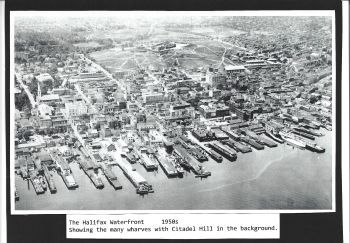
In the earlier days, the Halifax Waterfront was a very dangerous place for children to be as the wharves were old and dilapidated with some sections of the wharves collapsing and others had large holes in them. Many wharves were not fit to walk on, but numerous children in the down town Halifax area used these very wharves to play and swim off.
In the 1930s during the summer months, many young people would put on shows on the wharves for the people of the area on holidays or Sundays. The wharves were packed with hundreds of people to watch the antics of these kids; some even brought lunches for the day to observe the spectacle, that included swimming races, boat races and ‘fights’ with mops between two dories. Another sport involved water polo between two wharves using two of the pilings as goalposts. One game observers really enjoyed was known as ‘follow the leader’ where each of the participants had to replicate whatever the selected leader would do, from performing acrobatics on the wharf, to jumping from high up places onto the docks, or jumping in the water fully clothed. Late in the day, one could see various pieces of clothing apparel drying on the docks.
The section around Pier 2 had many tourist boats docked there. The patrons of the boats threw money over the side of the boats into the water and the young boys of the area would dive into the water to retrieve the coins. The police would never interfere. but rather would stay and enjoy some of the games while making their rounds.
Many children drowned from falling off these city wharves, where the water was very deep, as much as 15 feet. The waterfront seawater was also none too healthy to swim in as a sewer emptied into the harbour close by. The busy wharves held other dangers for children to stumble over, as they were usually full of old ropes, cables, high piles of fish and other crates. In 1938 The Halifax Mail Newspaper had an article in it regarding that some action should be taken to keep children off the waterfront wharves. The article continued that daily children, some of them very young, play there.
A few of the many tragedies that occurred:
In Nov. 1884 Hedley Walker, an eleven year old boy from Richmond was drowned by falling through a hole in the wharf which he was attempting to jump over.
In July 1939 Graham Wornell a five year old boy from Inglis Street drowned in a fall from Pier 30. Both he and his friend were fishing behind a high pile of empty fish crates at the end of the General Seafood Pier, when Graham fell off the wharf into the water. The depth of the water at the end of the wharf was more than 15 feet.
Another incident happened around the same time when three boys living on Upper Water Street rescued two younger boys who fell off Pier 2.
Lucky for them Harry Trider, Herb Willis and Thomas Sullivan were swimming in that part of the harbour when they heard the cries from the two boys. They saved the boys with the aid of a raft that had been moored at the end of the wharf. Such were the perils of youth trying to survive (during those times) in what could be considered as one of the
roughest parts of the city.