Fairview Historical Society Articles Archives
Home – Articles – Videos – eBooks & PDFs – Local Authors – Sponsors – Contact
Fabulous Old Time Pharmacy
Power Drug Store also known as The Railway Drug Store
Submitted By: Devonna Edwards
Thomas M. Power opened his first Drug Store in 1873 on Argyle Street. On December 1, 1897 he relocated and opened a new pharmacy on the corner of east side Barrington Street and Lockman Streets, present day North Street. It was known as The Railway Drug Store because at the time it was built, it was across the street from the North Street Railway Station, which was built in 1877 and demolished in 1920. The pharmacy was also described as being near the entrance to the Naval Dockyard in Halifax.
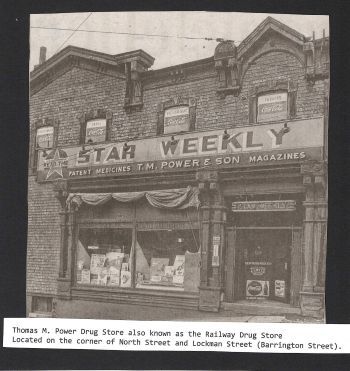
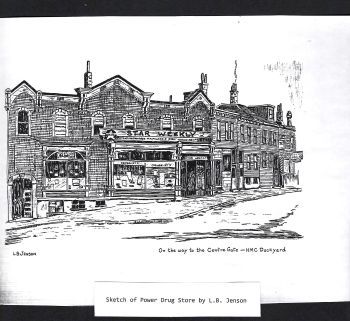
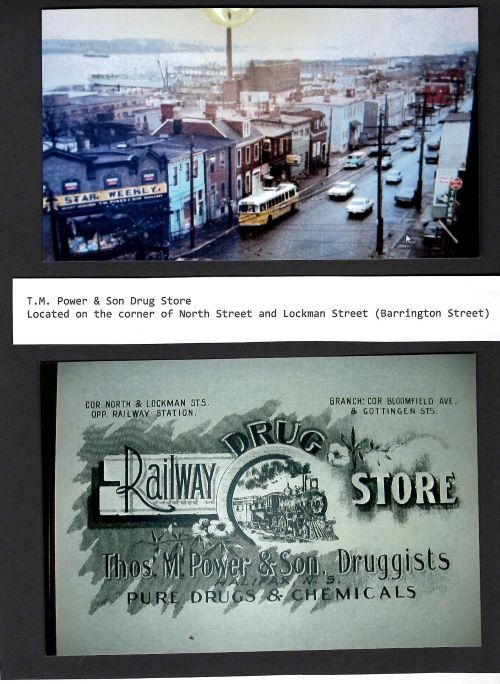
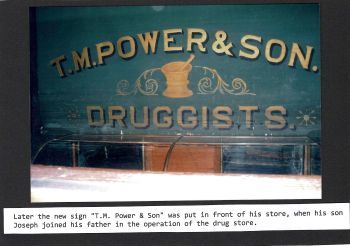
The grand old drug store building is described as being 58 ft. along the front, painted in green and gold. The larger window facing the front of the store was 15 ft. wide and 10 ft. high, with the upper portion fitted with art glass in scrolls and gems and contains the owner’s name in opals. The panelled side light in the main door on the right is figured with mortar and pestle of opals. It was described as being the most beautiful in the Dominion.
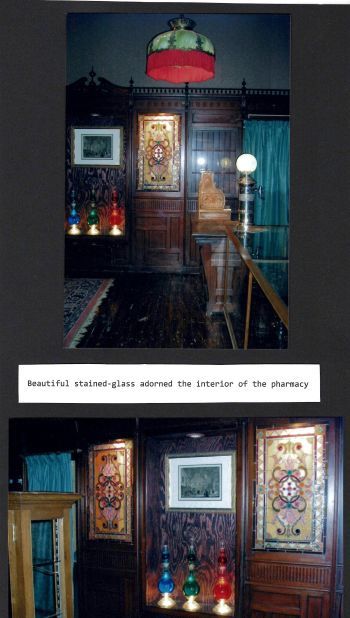
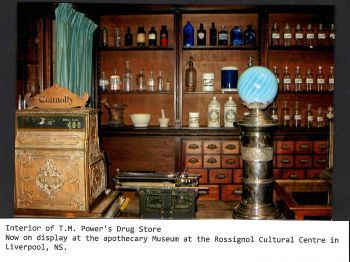
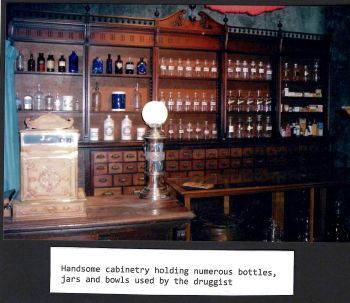
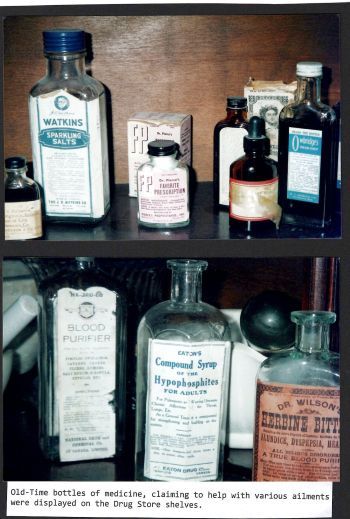
The second smaller window facing the front was 10 feet square and provided light to the office. A high centre pediment is crowned with a large golden mortar. Another pediment was inscribed in black and gold letter that said, “Railway Drug Store.” The building is wired and piped for either electricity or gas and is heated with hot water. The interior was both attractive and ornamental, finished with rosewood with brass mountings. The walls were coloured in mauve and gold papering which matched well with the ceiling tints. At the rear of the store was a handsome beveled plate glass mirror and two exquisite art glass panels. Rich beautiful dark cabinetry housed an array of colourful bottles and jars filled with an assortment of medication.
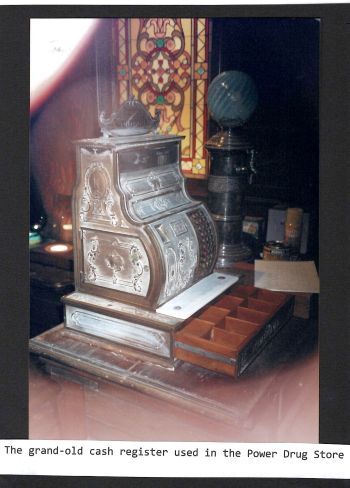
The stained glass windows in the fitted wooden interior were breath-taken in their design and the marble counter tops just added to the beauty of store. Dominating one end of the counter was a grand old brass cash register ready to ring-up sales. The ceiling was made of decorative steel panels and the shop floor was tiled in terracotta and blue with ornamental border. The entrance in the store was yellow and white in colour with a border and the main door was deeply recessed. The second door, which is the one on the left, in the front of the store was the entrance
to the office and to the second floor. H.B. Sellon was the architect of the drug store.
When the Halifax Explosion happened on December 6, 1917, the drug store received very little damage and was repaired several days after. It then became one of the main gathering places and a major support for survivors and workers, as lists and information were posted on the outside of the store. After surviving the Explosion, the Great Depression and the First and Second World War it became victim of urban development and the construction of the Sir. John A. MacDonald bridge.
This quaint old pharmacy closed its door in 1955 after serving the area for generations. The building was finally demolished in the early 1970s to make way for construction of ramps for the MacDonald Bridge. At that time the fitted wooden interior consisting of beautiful stained glass windows, marble topped counters, pharmaceutical storage drawers, shelving units and counters were removed and installed in the Belmont House on the Northwest Arm in Halifax and the rest of the interior is now at the Rossignol Cultural Centre in Liverpool. The Rossignol Cultural Centre set up a room which displays what the interior of the Power Pharmacy originally looked like, using original items from the drug store.
Today the site of the old Power Pharmacy would be where the Barrington Street approach ramp to the MacDonald Bridge is located. Thomas M. Power’s son Joseph F. Power, also became a druggist and opened his own pharmacy at 151 Gottingen Street which was a branch of his father’s Drug Store. Joseph Power had previously worked in drug stores through out Halifax, as well as in New York and in Florida. He served for three years in the First Great War and after returning graduated from the Maritime College of Pharmacy in 1926. Tragically, he died at the age of 60 years old. He went on a hunting and fishing trip on Nov. 2, 1946 and when he didn’t return, he was reported missing. Dragging operations at Lake McGrath and a thorough search of the wooded area off Prospect Road, in the Bayside area failed to produce any trace. His rowboat was found oarless near the shore of Lake McGrath. Finally on Nov. 7, his body was found in the water of Lake McGrath, off the Prospect Road.
He was survived by one son Thomas Roy Power. Joseph F. Power is buried at the Holy Cross Cemetery in Halifax.
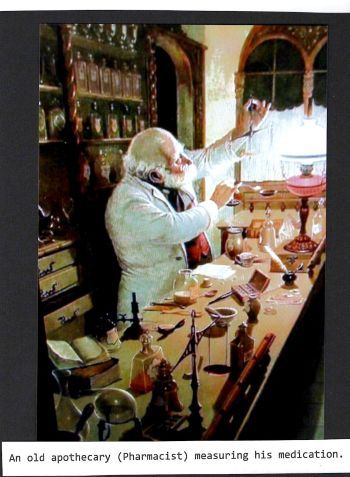
In the bygone days there were no Apothecaries (Pharmacist) in the province, but every doctor had a dispensary connected to his office. In his dispensary he had an assistant to help him prepare medication for his patients and over the course of time dispensaries were converted into shops where gradually other things were added to meet the public demand. That was the beginning of the early pharmacy’s and over the course of time apothecaries, who having received their training under medical men, decided to open shops of their own.