Fairview Historical Society Articles Archives
Home – Articles – Videos – eBooks & PDFs – Local Authors – Sponsors – Contact
The Halifax Dispensary
The Halifax Visiting Dispensary and Morgue
Submitted By: Devonna Edwards
During the 1850s medical doctors recognized the need to establish a medical and drug clinic for the poor in the city of Halifax.
The Halifax Dispensary
The Halifax Dispensary opened on November 9, 1829 on the corner of George and Granville Streets. It opened as a Walk-In-Clinic operated by Drs. John Sterling and William Grigor, where patients consisted primarily of the poor or immigrants in transit. The Dispensary consisted of a single square room (5m x 5m) and was open for the relief of any person who produced a certificate from a subscriber to the institution, from a magistrate or medical practitioner in Halifax. Treatment was denied to those who did not have a “good reputation”, such as alcoholics or those with venereal disease. Although the governor, as well as several clergymen and gentlemen of the town donated to the Dispensary it was impossible to keep up with expenditures, until the legislature provided a grant in 1831, still it was not enough to cover the cost of rent and medicines used in the Dispensary. The real advantage of the clinic enabled the sick to remain with their families rather than entering the Poor House. It was open every day, except Sunday, from 1 to 2 PM. Over 1700 patients were admitted to the facility during 1835.
The Dispensary moved to Bedford Row in late 1836 or early 1837. After the death of Dr. John Sterling in 1837, his son Dr. Thomas Sterling joined Dr. Grigor. Later Dr. Daniel Parker and Dr. Grigor’s Son worked at the Dispensary. In 1839 the Dispensary moved to Granville Street, behind the original St. Matthew’s Church. The Dispensary burnt down on January 1, 1857.
The Halifax Visiting Dispensary
The Halifax Dispensary was superseded by the Halifax Visiting Dispensary, with Dr. F. W. Morris serving as its resident physician. William Murdock was the president of the Halifax Visiting Dispensary, which had seventeen governors, including eight physicians. The Society supplied medicine, gave medical advice and performed surgical operations to anyone who needed medical attendance, not just to the poor of the city. This clinic provided services ranging from smallpox vaccinations to tooth extractions.
From 1855 to 1866, the Halifax Visiting Dispensary was located on Argyle Street in a house and was open from 12 noon to 2 PM, with two volunteer physicians on duty daily. In September 1867, the Dispensary was reorganized, with the staff being enlarged to include a resident apothecary and dentist.
The Halifax Visiting Dispensary was incorporated on April 18, 1872. In May of the same year, the Dispensary moved from Argyle Street to Grafton Street and in 1878 a branch of the Dispensary was opened in Dartmouth. By 1878, 540 patients had been treated in the Women’s and Children’s Department with Dr. Dodge in charge of the Eye and Ear Department.
In 1884 the churches in Halifax and Dartmouth offered a “Dispensary Sunday” or “Hospital Sunday” as it was usually known. Collections were taken in the different churches to benefit the Dispensary Fund.
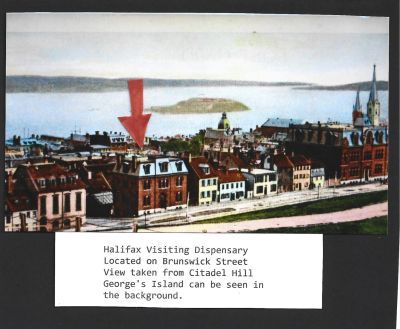
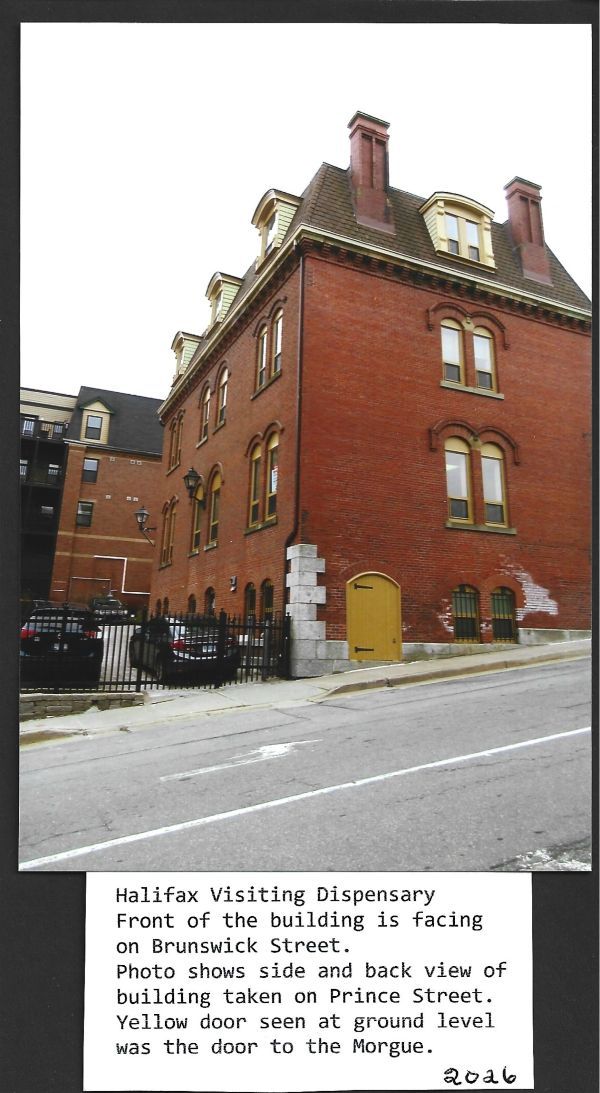
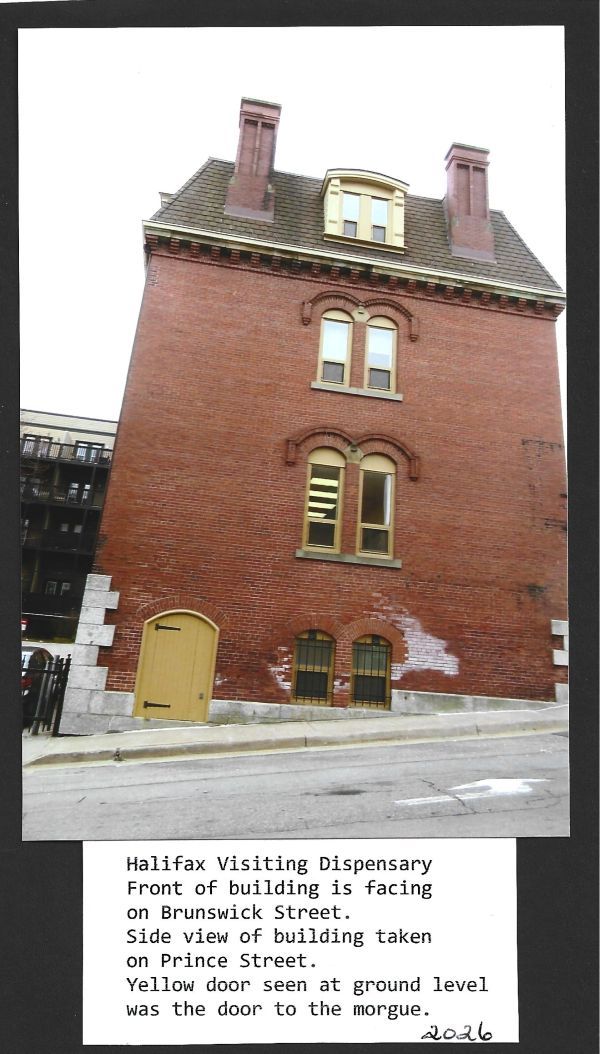
The Halifax Visiting Dispensary and Morgue
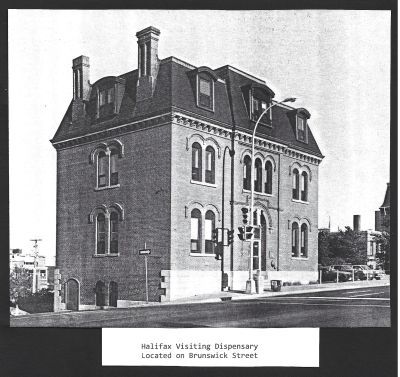
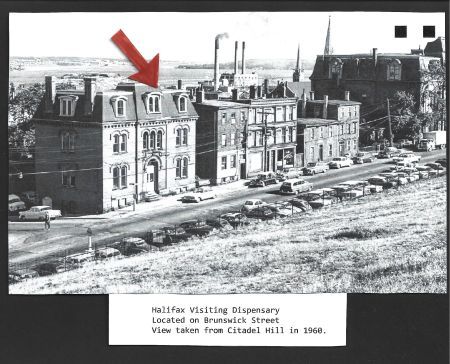
The dispensary and morgue were located on the corner of Brunswick Street (formerly known as Barrack Street) and Prince Street. It opened in 1876 and was in operation until 1926. Architect Henry Busch designed the Halifax Visiting Dispensary in 1875. The structure is composted of brick and measured 34 feet (11m) by 50 feet (16m). It was described as having a mansard roof with tall chimneys and a partial cupola to accent the centre. A row of brackets trimmed the cornice and the rounded windows were grouped in pairs with one centre triplet. The three-story building cost $13,000.
It had a morgue in the basement, which had its entrance off Prince Street on the side of the Dispensary building. The basement contained the necessary cellars and closets and in the north half, there were rooms set apart as a morgue and inquest room. There was a “dead” room with glass sides where the unclaimed bodies were laid out for identification and two small rooms for the Coroner’s purposes. Above the morgue on the first floor was the Dispensary along with four rooms, one each for the Departments of Medicine, Surgery, Diseases of Women and children, as well as the Eye and Ear Department.
The Apothecary and the large reception hall for patients were located on the same floor. On the second floor was the Board Room and on the northern end there was a large unfurnished room suitable for lodging. On the third, there were the Keeper’s apartments and three other small rooms. Later the second and third floors would be occupied by the Carpenter’s Union, the Anti-Tuberculosis League, the Tuberculosis Clinic, the Halifax Medical Library and the Halifax Welfare Bureau.
The Report of the Medical Staff for 1897:
Patients visited at their home: 1,087
Number of visits: 2,944
Patients attended at Dispensary: 3,352
Number of attendances: 6,864
Total number of patients: 4,489
Total number of attendances: 8,808
Total number of prescriptions dispensed: 10,120
The Dispensary closed in 1926, after that it was permanently housed in a new home at Dalhousie Health Centre. By 1949 the Outpatients at the Victoria General Hospital began to replace the service of the Halifax Dispensary. There was no socialized or government run medicine at the time, so patients services were either free (if on Welfare) or had to pay (either in part or in full) for the service.
The Dispensary had been an important organization in providing medical and surgical aid to people who were unable to procure help for themselves. That was the object of the Dispensary when it was first formed, but later the work was being done in conjunction with the Dalhousie Public Health Clinic, with the Dispensary’s primary function to fill the requirements of the Clinic. At that time all the Dispensary patients were children or the elderly, as the outpatient Clinic at the Victoria General Hospital took virtually all adult cases. It was believed to be the only Dispensary in Canada where a doctor could be called to visit someone in their home.
The Dispensary had four physicians, who made such visits. The organization then began to co-operate closely with the VON (Victoria Order of Nurses). In addition to its visiting physicians, the Dispensary also had four consulting physicians who worked with the patients as required. Examinations were made by the consulting physicians without charge of fees. In addition to its doctors, the Dispensary employed a full-time registered pharmacist and an assistant who worked at the Dispensary located within the Dalhousie Public Health Building on University Avenue. When Children’s Allowances, Mother’s Allowances, Old Age Pensions and various medical plans came into effect, as well as transfer of patients to the Victoria General Hospital Outpatients Clinic, the Dispensary’s
workload dwindled. The Visiting Dispensary received a major portion of its income from the Community Chest and also from investments of money bequeathed to them. They also received grants from the city of Halifax, the town of Dartmouth and Halifax County and a number of smaller grants.
The splendid old Halifax Visiting Dispensary brick building is still standing today on Brunswick Street.