Fairview Historical Society Articles Archives
Home – Articles – Videos – eBooks & PDFs – Local Authors – Sponsors – Contact
Submitted By: Devonna Edwards
A Walk Back in Time!
Two Famous Old Hotels from Halifax’s Past
The Halifax Hotel and The Queen Hotel
The Halifax Hotel
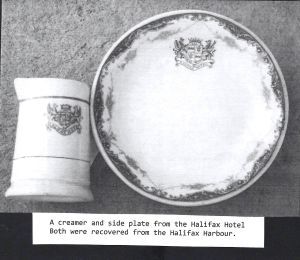
The hotel was built in 1839 on the eastern side of Hollis Street between Salter and Sackville Streets. The hotel building was four stories high in the front and five stories in the back. This first-class hotel was the largest hotel in the Maritime Provinces and opened in 1841 by a joint stock company called “The Halifax Hotel Company”. In its first two years of operation it was leased by Messrs. Hinkley & Parker of New York. After two years of trying to become established, their business venture failed. The hotel owners not ready to give up on their venture, reopened it under the management of Henry Hesslein, but by 1852 the hotel was closed again and Hezekiah Cogswell became the owner. That same year he leased the hotel to the army after the North Barracks was destroyed in a fire. The Army used the facility for many years as officer’s quarters. In 1861 Hesslein was running the Officer’ Mess, as well as the Acadian Hotel when he took over the lease and reopened the hotel. Under his direction the hotel thrived and by 1868 he became so prosperous that he purchased the hotel. In 1875 his sons Alexander and Lewis were taken into partnership. They added an extension on the south side which added an additional 32 rooms. In 1887 a new wing was built which provided an extra 100 rooms. The hotel had now grown in size to have a frontage of 48 metres on Hollis Street and by 1889 it extended to
Lower Water Street.
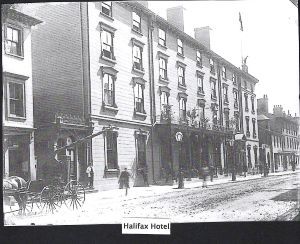
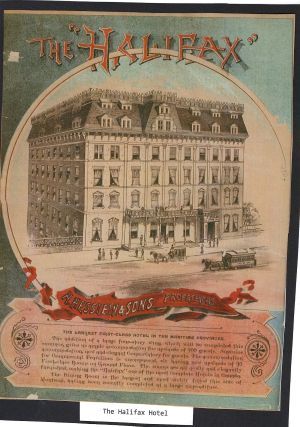
On the first floor there was a grand dining room, a ladies ordinary, the gentlemen’s and ladies drawing room, a smoking room, a reading room and also a bar room. The hotel had three different staircases going from the top floor to the bottom. The expansions continued and by 1889 the hotel could provide accommodation for 450 guests. The hotel was striking inside, with its marble flooring in the lobby, to the wonderful conservatory with its promenades and secluded retreats. White, gold and cherry trimmings flowed through out the hotel and at the head of the staircase was a large stained glass window showing art work. Large old fashioned fireplaces added to the glamour. The dining room was said to be the largest this side of Montreal after it was renovated in 1888. The main staircase that once ran to the rotunda was replace in June of 1897, when a Fenson electric elevator was installed much to the delight of both the guests and staff. The Halifax Hotel was the first hotel in Nova Scotia to install an elevator at that time. Hesslein also boasted that beside the English language, both French and German were spoken in the hotel. This popular hotel held many influential dinners and grand events.
When Henry Hesslein died around 1886 his sons Alexander and Lewis inherited the business and it flourished,
both had apartments at the hotel.
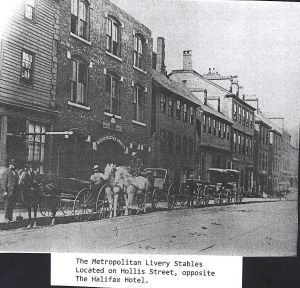
In the earlier years the hotel advertised “large and airy rooms”, all lighted with gas. In 1870 they added three outdoor gas lamps which illuminated the front of the building. They also had a hotel coach, towed by horses that served as a shuttle waiting on the arrival of all trains and passenger steamboats. The Metropolitan Stables was located across from the hotel which made transportation readily available and the “horse cars” (before city buses) passed the hotel every ten minutes.
The Halifax Hotel had the first complete hotel telephone system in Nova Scotia with a central exchange and long distance phones in every room. In 1912 the Halifax Hotel was fitted with fire escapes. Private baths with hot and cold water, suites with spring beds and elevators, all added to the mistic of the hotel in an age where such luxuries were not plentiful. The hotel’s conservatory and a colourful roof garden that was installed in 1903 overlooked the Halifax Harbour, certainly impressed the guests and made it a fashionable establishment.
After “The Halifax Explosion” of December 6, 1917, the hotel was used temporarily as the Emergency Reconstruction Office and Information Bureau which provided people with the latest news of body recovery. Some families stayed there while waiting to identify relatives. Edmund L. MacDonald purchased the hotel in 1931 and immediately sold it to Commercial Hotel, who remained its owners with MacDonald as the innkeeper until if closed in 1943.
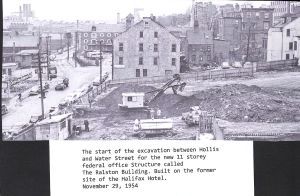
On May 14, 1943 the hotel closed due to bankruptcy and became a barracks for the RCMP. In 1948 the old hotel building was demolished to make way for the new federal government structure known as the “Ralston Building”. The Ralston Building was demolished in 2019 to make way for a 21 storey unit mixed development, called the Meridian which is anticipated to open in 2027.
The Haunting in Room 213 at The Halifax Hotel
It was said the every time a guest was put in there, they complained of Ghosts! This happened so often that the management had to use the room as a storage area. The story started in May of 1901 when an American women came to Halifax arriving on the Tuesday night train. She was described as a well dressed women, wearing a lot of diamonds. She had no baggage except a shawl strap and an umbrella. She arrived at the Halifax Hotel and signed the register as Mrs. Mary D. Eastman from Quebec. When she was escorted to her room number 213, she informed the maid that she needed nothing else for the rest of the night.
The next morning a maid visited the room and found her awake, but still in bed complaining of feeling unwell. She finally rose in the early afternoon, dressed and ordered her bill to be prepared since she might take the Maritime Express for the West later in the day. She left the hotel dressed in a fashionable black cashmere suit and hired a cabman named Tom Fraser for an hour. She asked him to take her to a store that sold fishing tackles and he took her to two stores, Sarre’s Store and Cragg Brother’s Store. At both stores she asked to buy a lady’s revolver, but Sarre’s didn’t sell firearms and Cragg Brother’s did not have a lady’s revolver in stock.
Finally they stopped at George E. Smith’s on the corner of Cheapside and Bedford Row where she went in and asked the salesperson to be shown a modern firearm and there she purchased a six-shooter, manufactured by the Harrington & Richardson Arms Company of Worcester, Massachusetts and a box of cartridges. Since her hour was not yet up with the cabdriver, she asked to be driven around the local points of interest in the area after which she returned to her room at the hotel. Later that day the maid went into the hotel room to clean, thinking that the lady had departed on the afternoon train. When she opened the door she saw Mrs. Eastman sitting motionless in an arm chair before a large mirror. The maid thinking that the woman was asleep approached her only to find she was dead. A revolver lay on the floor, with one chamber discharged, the bullet having entered the right side of her head. The police and the medical examiner were summoned immediately.
Dr. Flinn found a letter in the women’s purse, written in her hand requesting that the authorities, newspapers and others to make no attempt to find out her identity. The women went to great lengths to protect her identity. The letter was not written on the hotel stationary and the notepaper she had written on had the top part removed. That day had been warm, but she earlier requested a fire and the police found ashes in the grate, where she had burned a number of letters. She had removed her name tag from the shawl strap and from her clothes. Only one clue was left and that was a photo of a four year old boy with his name removed from the bottom. Her umbrella was stamped with the name of a New York manufacturer. The Medical Examiner concluded from her clothes, the condition of her teeth and from other evidence that she
was a lady of rank and refinement.
The body was placed in care of undertaker Spencer, pending identification. Moved by sympathy or curiosity, a large number of Haligonians visited the undertaker’s room to see the remains. Someone pinned a white carnation to the shroud, all remarked on the woman’s beauty. The crowds became so great that a magistrate ordered the public viewing halted; he found this “gratification of morbid curiosity” distasteful. Detective Power pursued what clues there were to the woman’s identity. While on route by train to Halifax, she stopped to have lunch at Amherst, where she used the name MacNamara. A report was received that a woman answering the description had registered at Saint John’s Dufferin Hotel, as Mrs. Mabel W. Cross, Wolfsboro, New Hampshire.
The Chief of Police also received a telegram from his counterpart in Sherbrooke, Quebec indicating that Mrs. Eastman may have really been one Madam De Marche, an actress and music teacher wanted there. It was suggested that “Cross”, “Eastman” and “DeMarche” were all aliases this woman had assumed. Finally the undertaker announced that unless the body of the unknown woman was claimed before the end of the week, the burial would be scheduled in St. John’s Cemetery. Eleven days after committing suicide she was buried, gracing the coffin was a single floral arrangement, sent by an anonymous sympathizer. The full service of the Anglican Church were not given because of the nature of her death. Prayers were followed by a brief reading from scripture. Crowds gathered along Barrington Street, as they watched the hearse pass, followed by several carriages, one of which carried three young men. The cost of the burial was borne by the undertaker Spencer.
The Queen Hotel
Formerly Known As “The International Hotel”
The International Hotel later known as The Queen Hotel was located on the eastside of Hollis Street between Sackville and Salter Streets.
The hotel was only three doors down from the Halifax Hotel and they became great rivals. The Halifax Hotel became known as a hotel, where the Conservative members gathered and the Queen Hotel was where the Grits went. Both hotels were frequent by the wealthy class. The Queen Hotel was built in 1849, but in 1873 it was gutted by fire and rebuilt. The five storey building was rebuilt into a strikingly, beautiful structure made largely of brick and supported with steel girders. Its entire flooring was of concrete with new manufactured tile covering. The walls were of cement on expanded metal wire, with the interior of the hotel being mostly wooden.
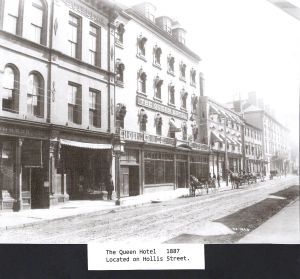
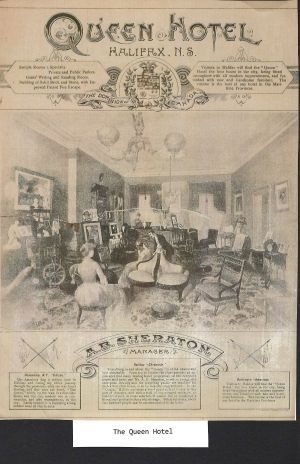
In 1886 it was renamed, “The Queen Hotel” by A.B. Sheraton. By 1911, the hotel was advertising a Roof Garden with a good view of Halifax Harbour and could accommodate 300 guests. It also said they had private and public parlors, an electric passenger elevator and 40 rooms with private baths. They also made known that they had new fireproof additions, such as an improved patent fire escape and that the hotel was built for safety and comfort. They boasted that the cuisine was the best of any hotel in the Maritimes. James P. Fairbanks was the Proprietor and he spent thousands improving the hotel facilities and expanding it onto an adjoining lot. It was advertised as having all the modern conveniences of any other larger hotel and said that the kitchen was one of the most complete and well arranged in the Dominion. The roof garden was shaded by an awning in the day and sparkled with electric lights in the night.
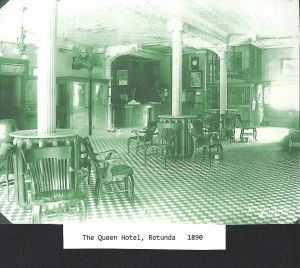
When the Halifax Explosion happened on December 6, 1917 the building suffered little damage, but the windows were all shattered and the doors had blown off. At the time of the Explosion pots, pans, dishes and the stove pipe were flying around, but the staff was not hurt, other than having a few cuts and bruises.
By 1930 the Queen Hotel was run down from the toll of the “Great Depression” and needed major renovations. In 1936 the hotel was purchased by John Simon for $17,500.
In March 1937 the hotel building was inspected by the Inspector of Factories, but the owners had not acted on many of the recommendations that were given and the Inspector did not follow up. The landings for the fire-escapes were wooden and there were no alarm systems or required escape ropes in the rooms. Negligent management and lax enforcement of existing safety regulations were responsible for the terrible fire on the morning of March 2, 1939. The fire rapidly consumed the entire building, killing 28 people. Many of the people were forced to jump out the windows to avoid the smoke and flames.
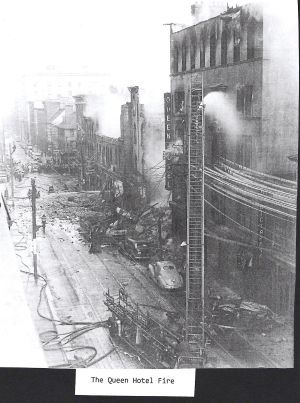
On the day of the fire at around 6 A.M. smoke could be seen coming from the furnace room and within minutes flames engulfed the hotel, racing through the elevator shaft to the upper floors, where it closed off what few escape routes available for the 90 guests and employees. The Fire Department was immediately called and the front desk clerk using the switchboard, tried to telephone the guests, but after only one guest was notified the smoke became too thick for the clerk to continue. The firemen arrived quickly, but had trouble raising their ladders due to the overhead power lines and trolley cables. There was only one ladder of sufficient length to reach the upper floors of the building and that 20 year old ladder was unsafe. The presence of live overhead wires, as well as not having up-to-date and speedy wire cutting tools, greatly hampered the rescuing efforts which resulted in many loss of lives. The courageous firemen did their best to save as many desperate people as was possible despite the many obstacles in their path. If it had not been for the heroic firemen, a lot more people would have perished that day.
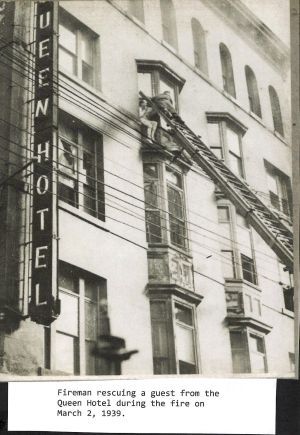
It became a scene of what nightmares are made of, screams could be heard as the people gathered at windows trying to escape the smoke and flames. Some tied bed sheets together to climb down to safety, others jumped into a safety net, held by firemen 30 feet below. By noon, fireman had the fire under control, but 28 people were dead, ten burnt beyond recognition and nineteen others had been injured. The hotel and two adjoining buildings were destroyed and all that remained standing were the skeleton walls. After two public inquiries were held, the final results concluded that the hotel owner John Simon was to blame. Safety features were non-existent, employees were not trained in what procedures to follow in the event of a fire. No escape route directions were posted anywhere and the exterior fire escapes had wooden landings that quickly burned away. Many rooms which had access to the fire escapes were locked and there was no fire alarm system or escape ropes anywhere in the hotel.
The cause of the fire was never determined. Although there were many theories, including one of arson by a disgruntled employee, nothing was proven.
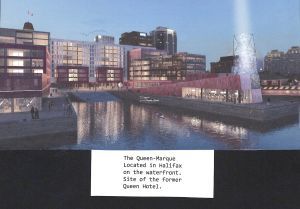
Today the Queen’s Marque is built on the former site of the Queen Hotel in Halifax. It is a mixed development which includes a luxury hotel, residences, office space, shopping and public space.