Fairview Historical Society Articles Archives
The Beginning
Orphanages in Halifax
Home – Articles – Videos – eBooks & PDFs – Local Authors – Sponsors – Contact
Submitted By: Devonna Edwards
Before the establishment of the Orphan House children needing care were looked after in private homes at the public expense, the caregivers were given a small allowance a week for clothing and provisions. This arrangement did not work out well, as the children were often neglected and treated badly.
The First Halifax Orphan House
The Orphan House stood beside the first Halifax (original) hospital which was erected in 1750. They both were located south of the palisades and just beyond Horseman’s Fort. The hospital was located on the present day site of the Government House on Barrington Street and the Orphan House stood next to it.
Edward Cornwallis, the founder of the City of Halifax, seen the need for such an establishment, as many foreign settlers coming from overseas had perished on their way to Nova Scotia leaving their children with no one to care for them. He was responsible for building Halifax’s first orphanage.
The Orphan House opened on July 8, 1752 to take care of all children in need, not only orphaned children, but those whose parents were either too destitute or ill to look after them. The Orphan House was administered by Rev. John Breynton and The Lord of Trade overseen the expenses of the House. Mrs. Wenman was the first Matron of the Orphan House, she was paid three pence per day for each orphan housed there and she had one assistant for every ten children, then later to a ratio of twenty to one. The Matron and her husband lived in the Orphan House and adjacent to it was a stone-house which was used as a workhouse.
The School Master taught them to read and instructed them in their “duty to God and their neighbours”. This instruction occurred from 9 AM to 5 PM, while the rest of the day was spent in picking oakum for the Ropeworks belonging to Mr. Wenman, the Matron’s husband. Other chores included carding and spinning wool, as well as knitting stockings for themselves. On Sunday the inhabitants regularly attended church. There were as many as 275 children who lived at the Orphan House at any one time between 1752 and 1760. Many of the children were a pitiful lot: “sickly, crippled, deaf, blind, feeble-minded or deformed”. They were given Spruce beer as it was thought to be good for their health, with the
remainder of their diet consisting of “bread, pork, beef and molasses”.
The children were also “apprenticed out”, with the boys bound to fishermen or some local traders, until they were “freed” at the age of twenty-one. Girls were placed in creditable families as servants, until they reached the age of seventeen years. Most healthy children were commonly bound out at the age of seven or eight years of age. If they were strong enough for employment, they were apprenticed out for twenty pounds sterling. Unfortunately, during their apprenticeship nothing was ever written that stated they were to be treated fairly, or how many hours they could work daily.
The clothing of the orphans which were made from the cheapest and most durable material that could be found, had to be returned to the Orphan House once the child was apprenticed out. The Orphan’s House was supplied with one cord of wood per week to heat the House in the summer and three cords per week in the winter, or two per week the year round.
During 1757-1758 almost half of the orphans there died from a smallpox epidemic. By 1774 the House was a “decaying, unlivable” structure and the orphan children were suffering greatly from the cold. In 1785 the Orphan House use was discontinued and in August 1788 the lot and orphan building was put up for sale. After leaving the Orphan House, the orphans were admitted to the Poor House and became the responsibility of the Overseers of the Poor. The Sisters of Charity established the first private orphanage in Halifax in 1849, followed by a Protestant Orphanage established by Rev. Fitzgerald Uniacke in 1857.
The First Poor House
Located on the north side of Spring Garden Road on property later known as Grafton Park. In 1754 the sick and the poor were cared for in a temporary workhouse, purchased by the government. The workhouse building was described as a log structure, forty feet (thirteen metres) by thirty feet (ten metres) situated upon an acre of ground surrounded by a high fence. In the foundation of the workhouse a ‘black hole’ was constructed as a cell for ‘solitary confinement’.
There was also a building for the Keeper, as well as a kitchen and a brew house. In 1758 a stone house was erected, sixty x 20 feet (twenty by seven metres) and twenty feet (seven metres) high. In 1763 an Act was passed that required three rooms in the Workhouse to be set aside for a Poor House, to be supervised by the overseers of the poor and supported by the Halifax Poor Taxes. The sick or weak should be taken care of by the Keeper of the House. In 1766 a tax was levied on spirituous liquors and on other imported goods to help with the expense, and in 1768 a surgeon was appointed to look after the sick, the orphans and poor children. In 1832 there were a total of 299 persons in the Poor House, another eighteen men and two boys in the hospital ward. In the garret (small roof loft or crawl space) for lunatics, there were forty-seven patients in eighteen beds. There was a complete absence of classification of disease: some were dying of old age, others with consumption (tuberculosis); still others with local ailments and more with infectious diseases such a typhus. The Poor House served as a General Hospital, Lunatic Asylum, Orphan House, Sailor’s Hospital, and a Lying-in-Institution (for maternity or childbirth). There were a hundred deaths annually.
The Poor House at that time contained seventy-four children (sixty-five of them orphans) under the age of ten years, forced to sleep with adult male and female inmates, without regard to fitness of health or morals. In 1846 there were 46 children in the Poor House.
The Second Poor House
A new Poor House was begun in 1867, by Henry Peters. It was located on the northeast corner of South and Robie Streets. The structure was made of brick and stone, 180 feet (fifty metres) by fifty feet(sixteen metres). It was the tallest building in Halifax at the time and the second largest within the province of Nova Scotia. The architect was David Sterling, who had planned it in the form of a Latin Cross by having its four wings radiating from a central building five stories high.
At midnight on November 7, 1882 a fire broke out in the kitchen. When the firemen arrived the fire was burning with great speed. There were three hundred and forty-three inmates of this institution who were terrified, but were unable to escape as the doors were locked. Old women and children stood at the windows screaming to be let out and when they saw the fireman they began to break the glass and prepared to jump. One member of the Union Protection Company used his axe to break down the door; the stairways were crowded and out rushed many women
holding little babies, men and women of all ages and sixty small children scrambled to safety. Thirty-one inmates died in the fire. The surviving inmates were transferred to the old abandoned Penitentiary at the North West Arm. A new structure was build on the same site as the Poor House. This new building was called The City Home.
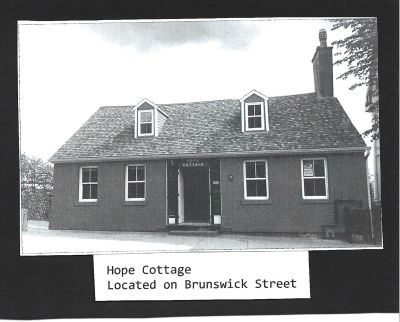
Hope Cottage
It was located on Brunswick Street and at one time it was used as an Infirmary for children that were left at the Catholic Convent or Glebe House. The Sisters of Charity cared for the children there. Any new children were placed in the Cottage before they went to the Home of the Guardian Angel. It was used as the Infectious Disease portion of the Home of the Guardian Angel. Years later Hope Cottage was used as a soup kitchen for homeless people, it was started by Father Joe Mills, who was pastor of St. Patrick’s Church.
Catholic Infant’s Home and Home of the Guardian Angel
The history of these two institutions runs from 1884 to 1991. They were facilities for the care of unwed mothers and babies. Prior to the opening of these homes in Halifax, there was no maternity home and homeless women found refuge during their confinement in the Poorhouse. Infant mortality was high; illegitimate babies were often disposed of at birth by women who had no means to care for them. Many tiny bodies were tossed in the Halifax Harbour, buried in shallow graves or simply dumped in outhouses.
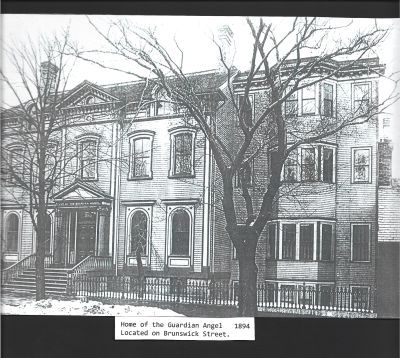
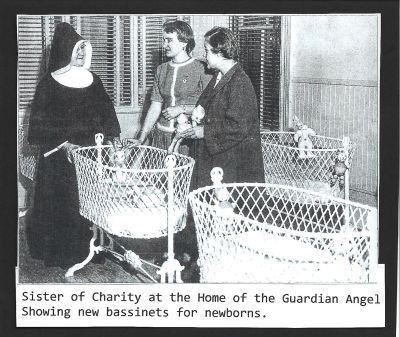
The Home of the Guardian Angel (Also called The Infant Asylum)
The Home of the Guardian Angel, previous to its opening as an Infant Asylum, had housed the orphans of the Catholic Diocese for many years. The Sisters of Charity established the Home which was located at 395 Brunswick Street, in the former home of James W. Merkel who was an auctioneer, commission merchant and banker. The Home was opened on October 20, 1887 by Archbishop Cornelius O’Brien to provide care for newborns, babies and to provide shelter for unmarried mothers after their confinement for up to six months; many children were also left on the doorsteps of the Home.
Although there were many donations for the support and operation of the home, it developed and grew for the most part through the spiritual and financial support of the Archdiocese of Halifax and the work of the Sisters of Charity of St. Vincent de Paul. Both St. Joseph’s Orphanage and the Home of the Guardian Angel were located on Brunswick Street, about a block apart. In 1894,the Archbishop had a large new Orphanage called St. Joseph’s Orphanage built on Quinpool Road and the Home of the Guardian Angel moved up the street to the vacant Orphanage at 395 Brunswick Street, where this large house was identified as the Catholic Infants’ Home for many years. Small children, up to school age were accommodated at the Home, at five years of age the child then was moved to St. Joseph’s Orphanage. During the Halifax Explosion on December 6, 1917, The Home of the Guardian Angel reported one child’s death and considerable damage to the building.
The first supervisor of the Home of the Guardian Angel was Mother Benedicta Harrington. She was an energetic woman, who ran the home with little available money, surviving on a small subsidy from the city of Halifax and money raised through a variety of community projects. In the early years there were many actual “foundling”-little bundles left on the doorsteps of the home, but the more common practice however, was to admit an unmarried mother to the Home after the birth of her baby. However by 1941 it had become the practice to admit women before the child’s birth, so that during the final months of her pregnancy she would have shelter, adequate nourishment, as well as proper care.
At this time, the children of St. Joseph’s Orphanage were attending neighbourhood schools rather than being taught in the orphanage. Those circumstances created extra space in the orphanage building and in 1955 the Home of the Guardian Angel was moved to the east wing of the orphanage, where Sister Mary Clare and John Elizabeth set up a shelter for unmarried mothers, as well as adoption agency. With the closing of St. Joseph’s Orphanage complex in 1970, the Home of the Guardian Angel moved to a renovate house at 6345 Coburg Road in 1974. The Guardian Angel also opened a Single Parent Centre in Spryfield in 1980. One year later, a special residence was opened for expectant mothers on Larch Street and this maternity residence closed on August 31, 1991.
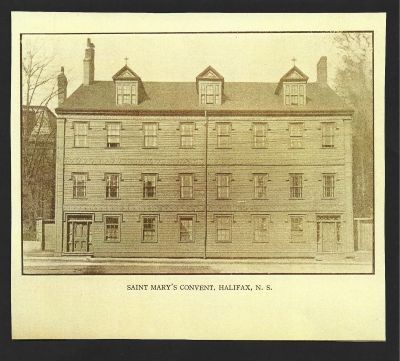
Sisters of Charity
The Sisters of Charity have taken care of orphans as early as 1849 when four Sisters arrived in Halifax, on request of Bishop William Walsh to care and educate orphans in his diocese. The Bishop gave them a house on Barrington Street next to St. Mary’s Church. On the very first day that they occupied their new quarters, they took in a little orphan girl. There they opened a school teaching Catholic children, many were Irish immigrants fleeing the Great Famine in Ireland. By the end of the school year in July, their classes had 400 children in attendance. The busy Sisters also housed 20 little girls in their own homes and began caring for the sick.
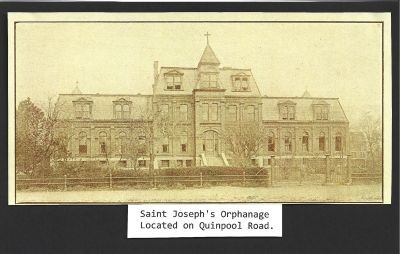
Saint Joseph’s Orphanage
In 1868 St. Joseph’s Convent and Orphanage was opened in land adjoining St. Joseph’s Church in the north-end of Halifax. The Orphanage was started by The Sisters of Charity who cared and educated orphan children of the diocese. It was opened by the pastor of St. Joseph’s, The Reverend T.V. Allen. In 1872 St. Joseph’s Orphanage was transferred to Archbishop’s residence on Dutch Village Road, while a new building
was being constructed on Gottingen Street that opened in 1873. This building was damaged by fire in 1881 and St. Joseph’s Orphanage was moved to St. Mary’s Convent temporarily. In 1883 St. Joseph’s was moved to a large building on Brunswick Street, approximately a block north from St. Patrick’s Church.
Archbishop Cornelius O’Brien bought 15 acres (six hectares) of land on Quinpool Road. The property was purchased from William Humphrey who had a farm there, which stretched up Quinpool Road from what is today called Monastery Lane to Windsor Street.
By 1899 three Massive Catholic buildings were standing on the north side of Quinpool Road. Today all three buildings have been demolished and Quinpool Centre was built on the site. These three buildings were The Monastery of the Good Shepherd, St. Joseph’s Orphanage and The Holy Heart Seminary.
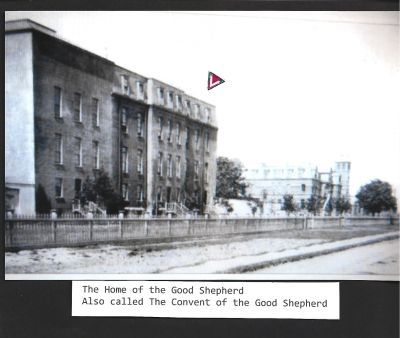
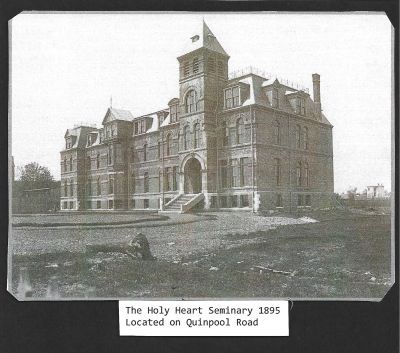
1) In 1890 “The Monastery of the Good Shepherd” also known as “The Convent of the Good Shepherd” or “The Home of the Good Shepherd” was built at the west end of the property, close to Monastery Lane. This was a home and training centre for delinquent Girls and unwed mothers. They also had a ‘Magdalen Laundry’ in the Home. It closed in 1970.
2) A huge new structure to the east of the property called “St. Joseph’s Orphanage” was completed and opened in 1893, by Archbishop O’Brien and closed in 1968.
3) In between the Monastery of the Good Shepherd and St. Joseph’s Orphanage stood another building called “The Holy Heart Seminary”, which was a diocesan seminary. It opened in 1895 and closed in 1970.
St. Joseph’s Orphanage continued to expand over time until it covered an area almost double its original site. The last addition was completed in 1923 and this was made possible by charitable subscribers from various parishes of Halifax, under the Archbishop McCarthy. The children in the orphanage had a common school education and could continue their studies at the public high schools in Halifax. It was ran by the Sisters of Charity to provide care for children over the age of five years old. In 1917 during the Halifax Explosion, the orphanage did not suffer any loss of life, but the building was damaged and later repaired. In 1891 the Province recognized the Sisters of Charity as being in care and control of St Joseph’s Orphanage, but in the late 1960s the Province of Nova Scotia became increasingly involved in the care of orphans and pushed forward with the foster care program.
On March 1, 1968 St. Joseph’s Orphanage transformed into St. Joseph’s Children Centre, a non-profit organization for children with special needs. St. Joseph’s Orphanage closed on March 1, 1968.
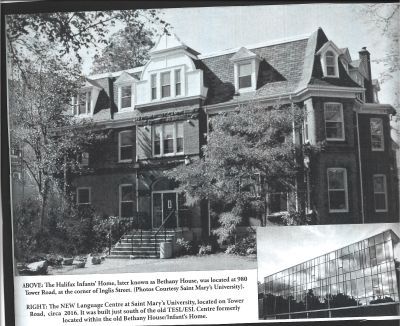
The Halifax Infant’s Home (Later known as Bethany House)
The original purpose of this institution was to care for foundling (abandoned) children. Funds were raised by the local Council of Women, a precursor to what today is Social Assistance. The Home gave shelter and medical assistance to unwed mothers and their babies, but in 1924 it was decided to close the maternity ward at the Home and leave that aspect of their work to the Grace Maternity Hospital. At that time the Infant’s Home had a fourteen bed private hospital and 110 children had been received into and were cared for by the institution.
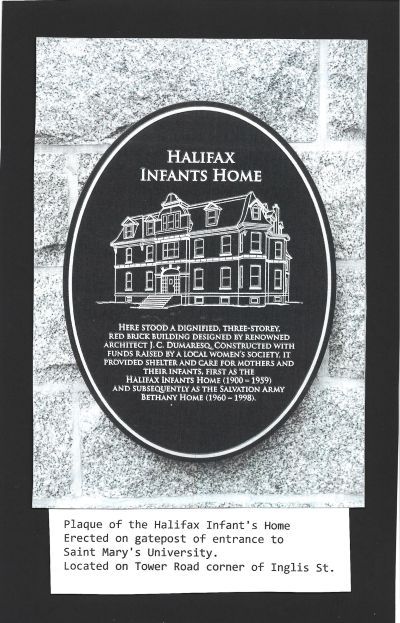
Land was bought on the site of the old Belvidere House on Tower Road, at the corner of Inglis Street in the south end of Halifax. After the house was demolished, a new structure was built for the Infant’s Home. It was described as a red brick, three storey structure with many windows. It was designed by J.C. Dumaresq in the Second Empire Style, with unique tower-like features. Inside the building there was solid dark woodwork and was divided into bedsitters and small rooms for single girls.
The Halifax Infant’s Home was later known as Bethany House, when it was sold to the Salvation Army who ran the Home for unwed mothers and their children from 1960 to 1998. The Home was purchased by Saint Mary’s University in 1998 and was demolished in 2013 to make room for a new building, known as The New Language Centre, used by the University to teach English as a second language.
A plaque now commemorates the Halifax Infant’s Home, it is affixed to a fence near where the former Home once stood.