Fairview Historical Society Articles Archives
Home – Articles – Videos – eBooks & PDFs – Local Authors – Sponsors – Contact
Tuberculosis and Related Institutions
“They’re not getting any more of my ribs!”
Submitted By: Devonna Edwards
Tuberculosis commonly abbreviated as TB, was also commonly known as Consumption, The Great White Plague and Phthisis. It is a highly infectious disease caused by bacteria and generally attacks the lungs, but can also affect other parts of the body such as the central nervous, lymphatic, circulatory, urinary-genital tract and gastrointestinal systems, as well as bones, joints and skin. When found in the lungs it is usually referred to as Pulmonary Tuberculosis.
The symptoms of this disease involve chronic cough with blood tinged sputum, fever, chills, night sweats, weight loss, pallor and fatigue. tuberculosis is spread through the air, when people who have the disease cough, sneeze or spit; tuberculosis can also be carried by some wild animals. Tuberculosis was also called, ‘The King’s Evil’ which was tuberculosis in the neck and lymph glands, also called scrofula. In earlier years monarchs actually touched those afflicted, as the general belief was that the king’s touch would cure it. People suffering from Tuberculosis often lost their jobs, and were shunned by neighbours and friends because they were afraid of catching the disease. The disease is rarely seen in the Maritimes today, but in earlier years it was one of the Nation’s worst killers.
The City Tuberculosis Hospital
The Nova Scotia Tuberculosis Commission came into being because Nova Scotia had the second highest death rate from tuberculosis in Canada. It had the financial support of the government and of the Canadian Anti-Tuberculosis League. Vital statistics for the City of Halifax for 1868 were: 400 marriages 1136 births and 756 deaths and of the latter deaths, tuberculosis had claimed 144 people. Institutions were opened to treat people who were afflicted with this disease and to prevent the spread of the disease. People with TB did not have a choice in this matter: they had to leave their home and family and enter a sanatorium, which was the law at the time. These institutions were large treatment centers that specialized in the diagnosis and the recovery of patients with tuberculosis. They illustrated the value of rest, fresh air, good nutrition, as well isolation to prevent the spread of infection. Prior to the discovery of anti-tuberculosis medicines in the 1950s, it was familiar practice to collapse the disease lung by inserting a thick substance such as paraffin into the chest wall or by removing ribs, two or three at one time, but one could actually remove up to eight ribs over time. Many patients were overheard to state: “They’re not getting any more of my ribs”.
In 1891 Dr. D.A. Campbell started the isolation of Tuberculosis at the Victoria General Hospital. In 1901 separate wards were developed at the V.G. Hospital for infectious disease.
The Highland View Sanatorium
Nova Scotia’s first sanatorium was the Highland View Sanatorium located in Amherst, Nova Scotia. This hospital had eight beds and operated from 1899 to 1903. The next sanatorium to open was the Provincial Sanatorium at Kentville, Nova Scotia. It was an eighteen bed institution and many people referred to the hospital as the ‘San’. Tuberculosis cases in Halifax and Dartmouth in those earlier years were sent to the Provincial
Sanatorium in Kentville, which was built in 1913 at a cost of $20,000.
The Hazelwood Hospital for Tuberculosis
In 1914 the Hazelwood Hospital for Tuberculosis was financed by the Anti-Tuberculosis League. It has thirteen beds and was located between MacDonald Street and the railway tracks, near the head of the North West Arm. The building was later removed when the railway tracks were extended. When the increased number of cases made it impossible to obtain accommodation at the provincially owned and operated Sanatorium in Kentville, they built the Morris Street Hospital in Halifax.
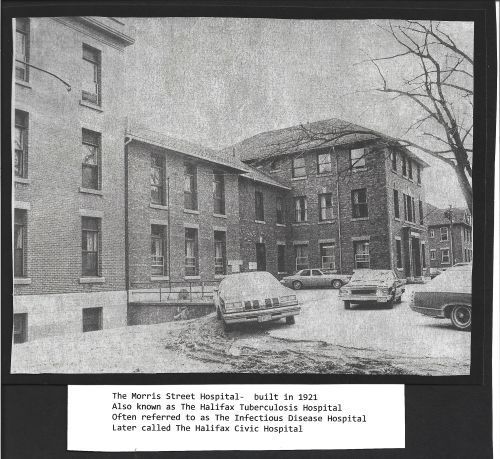
The Morris Street Hospital later known as The Halifax Tuberculosis Hospital
Also referred to as The Infectious Disease Hospital and later The Halifax Civic Hospital Morris Street later changed it name to University Avenue. The hospital was built in 1921 and contained fifty-eight beds and was under the management of the City Home. One side of the Morris Street Hospital was for Tuberculosis and the other side was for scarlet fever, measles and diphtheria cases.
By 1942, A.R. Morton who was the Health Commissioner said that there was a large waiting list for admission to the Tuberculosis Hospital, commenting that hospital space was insufficient with only sixty-five beds on hand. Some also argued there should be provisions for fluoroscopy or X-rays for school children and further stated that some years ago the city had requested help from the Provincial Government in maintaining the Tuberculosis Hospital, but had been refused on the grounds that Halifax citizens had the advantage of the facilities of the Victoria General Hospital at lower rates enjoyed by residents elsewhere in the Province. The Health Commission moved that Mayor Donovan appoint a sub-committee to approach the Provincial Government again regarding a better solution to the problem. The number of deaths due to Tuberculosis increased significantly after both the First and Second World Wars.
In December 1927, The Halifax Herald and The Evening Mail posted this advertisement: “Needless loss of life from Tuberculosis. One out of every ten deaths in Nova Scotia is due to Tuberculosis. That is seven hundred deaths (annually) and 7,000 in a decade, leaving behind many cases of wrecked homes, in every case a trail of suffering. The deaths from Tuberculosis is worse than war worse than the Halifax Explosion. The tragedy of it is that prevention and early treatment would stamp out this dread disease.”
The Nova Scotia Tuberculosis Commission, Pathological Institute of Halifax, Canada was responsible for this advertisement: “The Nova Scotia Tuberculosis Commission co-operates in every way with the medical men of the province in stamping out this disease.” They put out a plea that if anyone knows of a person suffering from TB, who is not receiving help and not in a position to receive proper medical care, to please contact them. In 1946, The Morris Street Hospital became known as The Halifax Tuberculosis Hospital.
On January 15,1959 the City Council renamed the Tuberculosis Hospital on Morris Street, ‘The Halifax Convalescent Home’, although the Convalescent Home had already been in operation there since August 1, 1942. Part of the Convalescent Home was still being used as The Nova Scotia Rehabilitation Centre.
The Convalescent Hospital name changed to ‘The Halifax Civic Hospital, approved at a City Council meeting on January 14, 1965. It was an active treatment hospital and had fifty-three beds, roughly divided equally between male and female patients. Children under the age of fifteen were admitted only under special circumstanced. It received most types of illness that did not require the special investigative and nursing services available only at The Victoria General Hospital and The Halifax Infirmary. The facility had its own X-Ray Department, Laboratory, ECG Department, Physiotherapy Department, and Minor Surgical Procedures Department.
During the 1960s, The Infectious Disease Unit was housed on the third floor of the Halifax Civic Hospital, immediately adjacent to the Children’s Hospital. Many of the children had communicable diseases and were isolated in separate rooms within the institution. Some of these children were admitted with TB. Visiting hours were limited so it must have been frightening for the young children to be separated from their families for long periods of time. Adding to their dread, nurses had to wear a face mask and double gown which is the wearing of one isolation gown on top of another. The old hospital was demolished in the 1970s. Today The IWK Parkade and Newman Gardens occupy the former site on University Avenue.
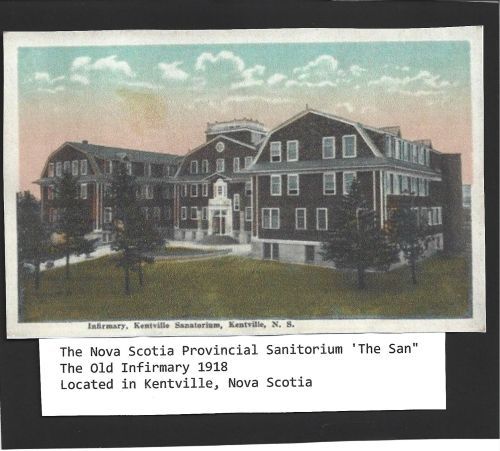
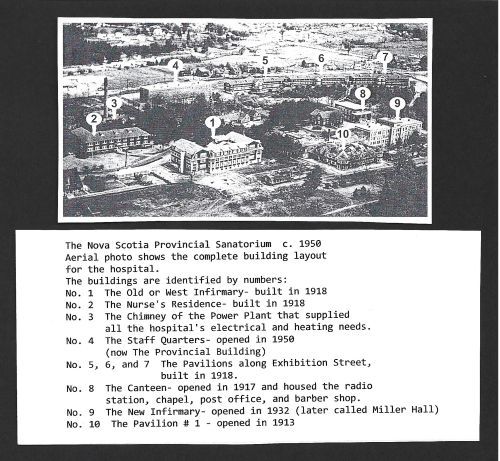
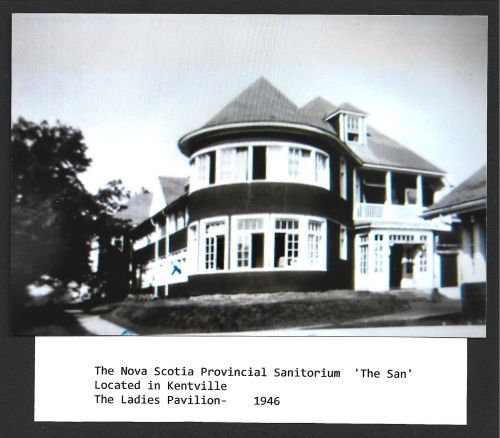
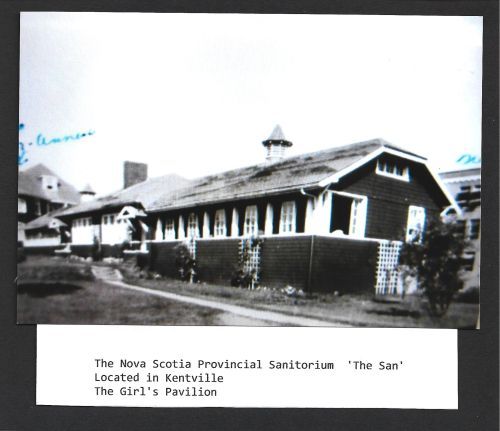
The Nova Scotia Provincial Sanatorium
Also referred to as ‘The San” The Sanatorium was located in Kentville, Nova Scotia and opened in 1904 due to the rising number of
people with Tuberculosis (TB). The Provincial government built the first Provincially owned and operated Sanatorium in Canada to treat TB. The building consisted of 18 beds, but as Tuberculosis spread the complex expanded to 20 buildings and could house 400 TB patients. People with TB from all over the province travelled there to receive help and be cured. Between 1910 and 1916 Dr. Miller was the only doctor there. Over time ‘The San’ complex became entirely self-sufficient. It has its own power plant, laundry, post office, fire department, radio station and monthly magazine.
The complex consisted of: A Pavilion which opened in 1913,The Old or West Infirmary built in 1918, a nurses residence built in 1918, the chimney of the power plant that supplied all the hospital’s electrical and heating needs, the staff quarters which opened in 1950 and later became The Provincial Building, six pavilions were built in 1918, a canteen which opened in 1917 and housed the radio station, chapel,
post office and barber shop. Several more buildings were erected until 1932 when a new infirmary opened, which later was known as Miller Hall.
The earliest patients were soldiers who returned home from World War 1 suffering from Tuberculosis. In 1916 one hundred soldiers were admitted to the hospital and in 1917 another one hundred were admitted for treatment. Some patients remained at the institution for many years and could not go home until they were cured. Their families had strict vising privileges and although it must have been nice to see them when they visited, I am sure it didn’t cure their loneliness. The staff at ‘The San’ celebrated all the holidays by decorating and having a celebration with the patients. The treatment for patients at the institution was bedrest, a healthy diet and lots of fresh air, which was a
problem in the summer months because all windows were kept open, but none had screens on them and the annoying mosquitoes were plentiful.
In 1975 ‘The San’ was amalgamated with the Blanchard-Fraser Memorial Hospital and became known as The Miller Hospital for Diseases of the Chest and ‘The San’ no longer existed. Over the years all the original buildings in ‘The San’ complex were demolished, the last one being in 2003.