Fairview Historical Society Articles Archives
Home – Articles – Videos – eBooks & PDFs – Local Authors – Sponsors – Contact
The Halifax Explosion Dec. 6, 1917
No. 10 Train, Actual Encounters of Horrific Events of That Day
Submitted by: Devonna Edwards
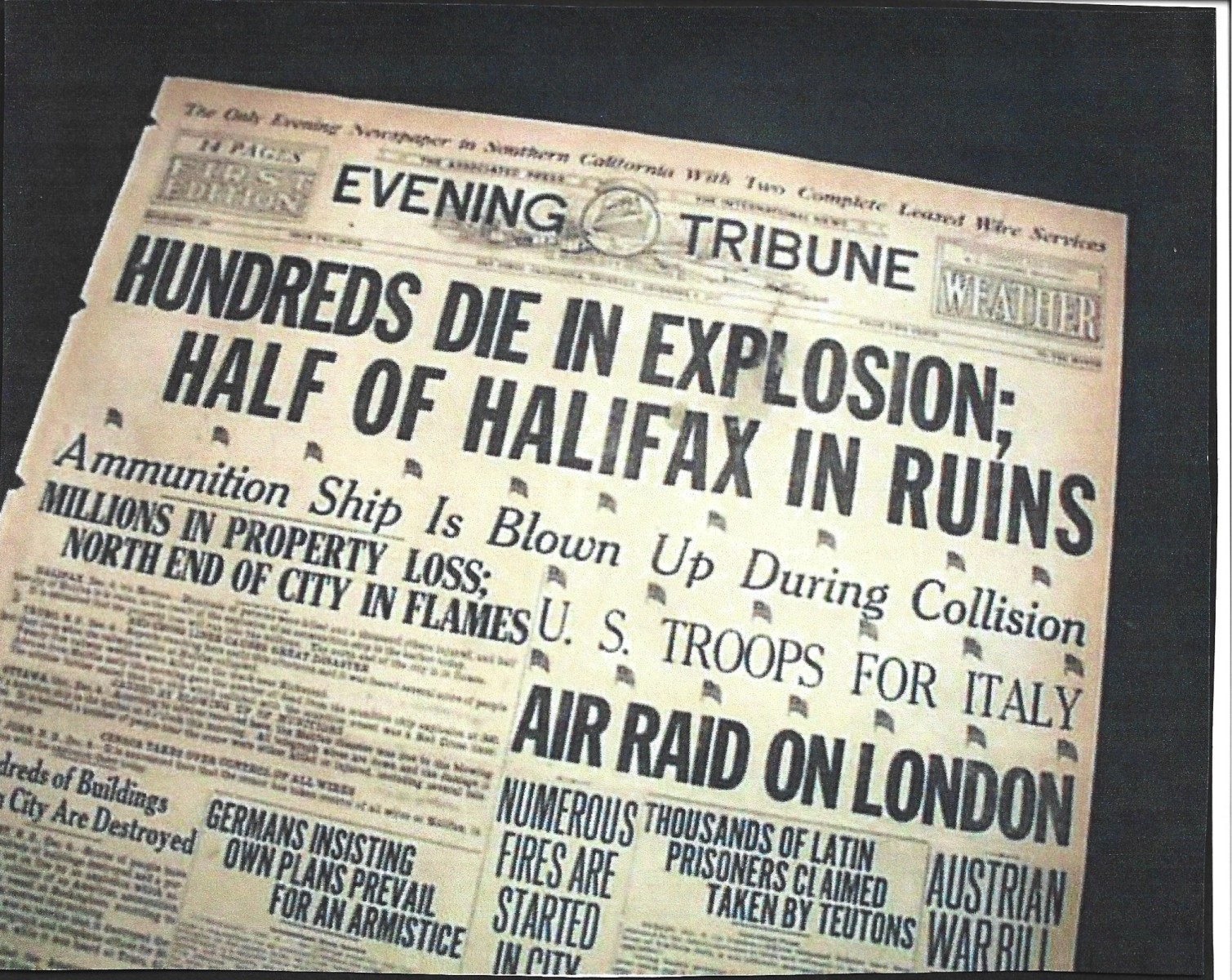
On the morning of the disaster the night express from St. John, New Brunswick known officially as No. 10 Train, was nearing Halifax. It was made up of engine, postal car, baggage car, a second-class and a first-class coach and two pullman cars. Conductor J.C. Gillespie was in charge of the train. At Bedford it was ten minutes late and therefore did not reach Halifax in time to share the destruction which overtook the North End. Indeed, this particular train never reached Halifax at all. It was approaching Rockingham when the shock of the Explosion struck it. The cars were tilted violently over on the trucks as far as safety-chains would permit and then clashed back into their usual position. The glass broke gently all along the train, coming inside but injuring none of the passengers. The engineer was thrown against the boiler-head and badly hurt, but he struck to his post as engineers do and stopped the train. No one knew what had happened. A Canadian officer, lately returned from France described his impression, “It was as if a torpedo had struck the train”. After waiting about fifteen minutes, the train proceeded to Rockingham and then crept up to Willow Park Junction, to a point between the black settlement called Africville and the wrecked district of Richmond, just before the streets of Halifax proper begin.
As soon as the train stopped there was a rush of injured persons towards it-‘hundreds’, according to one eye-witness. They were as black as if they had been shovelling coal and streaming with blood. Some were carrying helpless ones in blankets or sheets and all were frantic with pain or fright and crying out for relief, but there was no medical man on board the train. One of the passengers volunteered to go for a doctor, but seeing the destruction of the city
and the hopelessness of his errand, he turned back to give what he could on the spot. The conductor of the train is like the captain of a ship, he is in command and he is responsible for lives and property. Conductor Gillespie was suddenly placed in a situation not provided for in the railway rules and regulations. The wires were all down, he could not get into communication with anyone of his supervisors or obtain instructions what to do. He saw cold, barefoot and torn people needing shelter and help and in his own words, he ‘went to work’. The baggage and postal cars were emptied of their contents, luggage and mail-bags were thrown out beside the track to make room for the injured. Train crew and passengers were aided by willing helpers, soldiers, sailors, and civilians, who came upon the scene. One of the men devolved the task of carrying the wounded persons and getting them into the cars. The women passengers set to work making bandages out of the bed and table linen found in the Pullman cars and when that supply was exhausted they tore up their own underclothing. Water to bathe the wounds was obtained by running it off
from the engine.
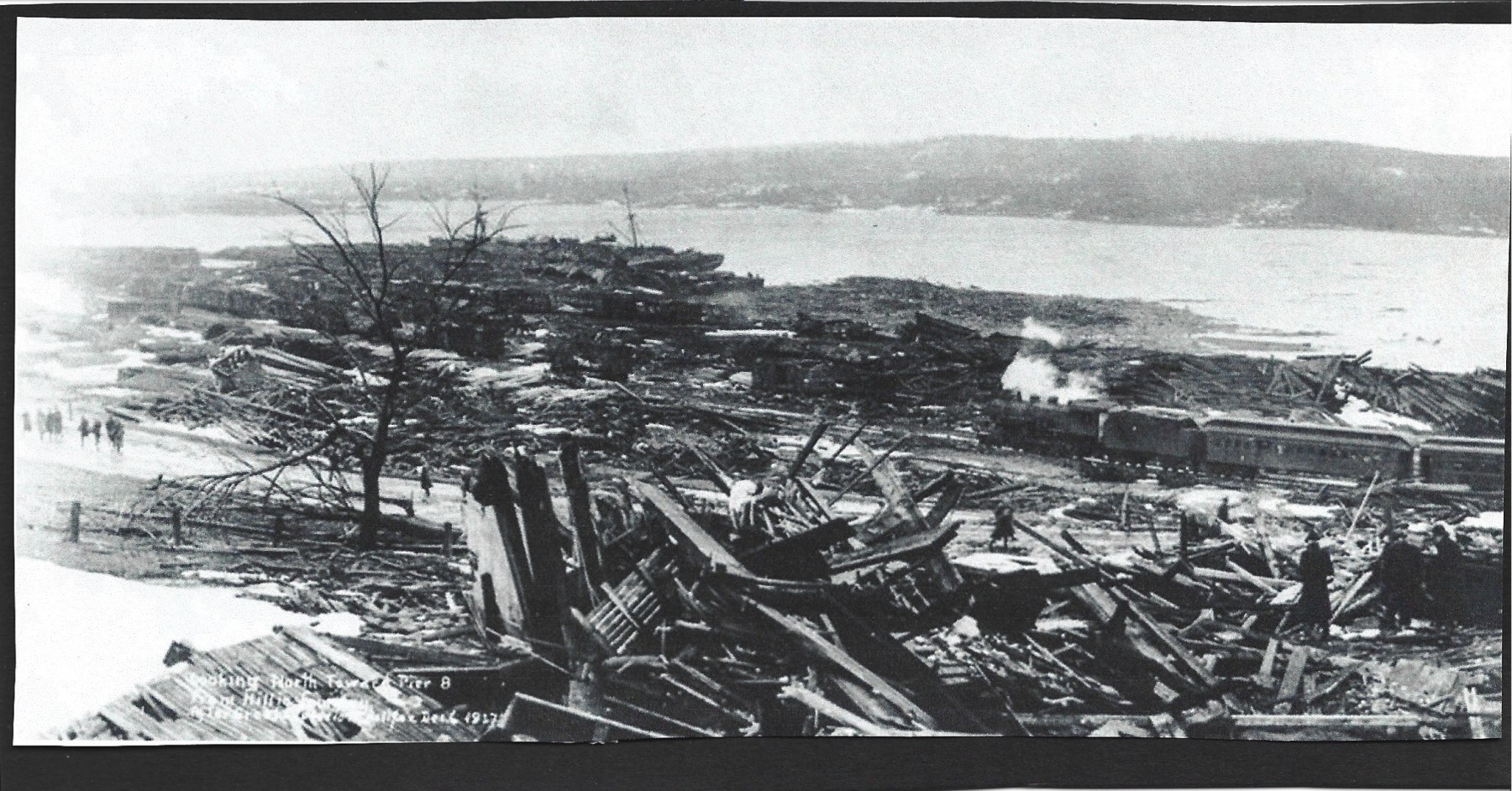
After labouring in this way for perhaps half an hour the workers became aware of something even more dreadful than the heart-rending sights before their eyes. Shrieks of agony rose from the ruins of the houses round about, then they realized that the houses were on fire and in them were living, sentient, human beings in danger of the most horrible of deaths. The men left the women in charge of the wounded in the train and organized themselves quickly into rescue parties. Working desperately, by the utmost exertions they saved life after life, but in some cases the heart-sick rescuers were unable to penetrate the barriers of flame and those withing perished with help only a few feet away. That was the chief horror of this day of horrors! The only tools available for attacking the burning piles were the axes and saws kept in the train cars in case of accident. Beams and planks were used as levers to prise the wreckage up and apart, the only effective implement, said one of the rescuers, would have been a gigantic crane to lift up the heavy masses of woodwork off the people buried beneath. For the most part, the men had no tools, but their bare hands with which they tore the tangled planking under. After making some progress, they would be checked or thwarted by coming upon entire sections of roof or walls which could not be lifted or pushed aside. One party of six men was engaged in working at one house until one o’clock, in it were a man and his wife, another woman and a small boy. When rescued at last, the man was quite unhurt, but his wife was severely cut about the face and blinded. On being brought out she kept her hand over the eye, which has been destroyed so that her husband could not perceive her injury. A worker in this party tells that the next house was on fire and that there were four children in it. The parents ‘went on like maniacs’, but it was not possible to get the children out.
Very soon after the train came to a standstill, men in uniform began to come upon the scene one at a time. Some had bandages on their heads or arms, some were maimed, with one arm or one leg, a number were dressed ‘improperly’, as the army phrase runs. These were undoubtedly hospital patients who had been dismissed from Rockhead Prison that morning when the injured poured in for treatment, others had come from the hospital at Pier 2. There were some fifty in all. On the train that morning was Col. E. C. Phinney, who had been in command of the 85th Battalion, C.E.F. in France. He was in uniform and quickly organized these soldiers into working parties and pursued the work of rescue as systematically as possible. They ascertained as well as they could, if anyone was alive in a house. If there was no one, they let it burn and went on to the next. These men, collected by chance, worked remarkably well together and showed the results of the discipline they had undergone and their familiarity with danger and death. The rumour of the second explosion reached these workers in the mysterious way that rumour is communicated, for they were not officially warned. Col. Phinney pointed out to them that there was no likelihood of avoiding danger by leaving their task. The best thing to do was to ‘stick it’. Their response was ‘sure’ and the informant added, ‘they went to it’. That morning at least forty, possibly as many as sixty persons were rescued from the burning houses. They were chiefly babies, small children and old people.
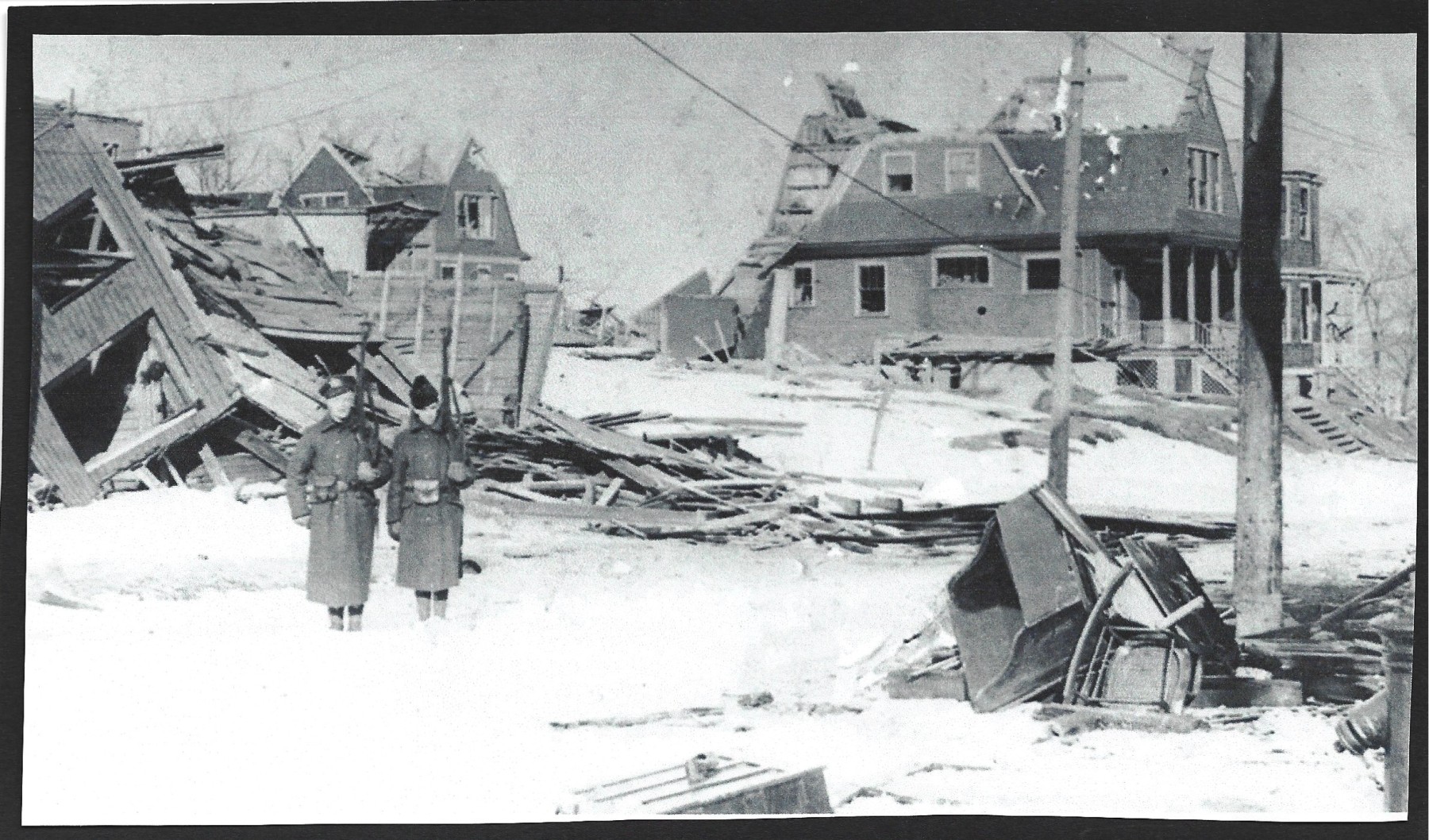
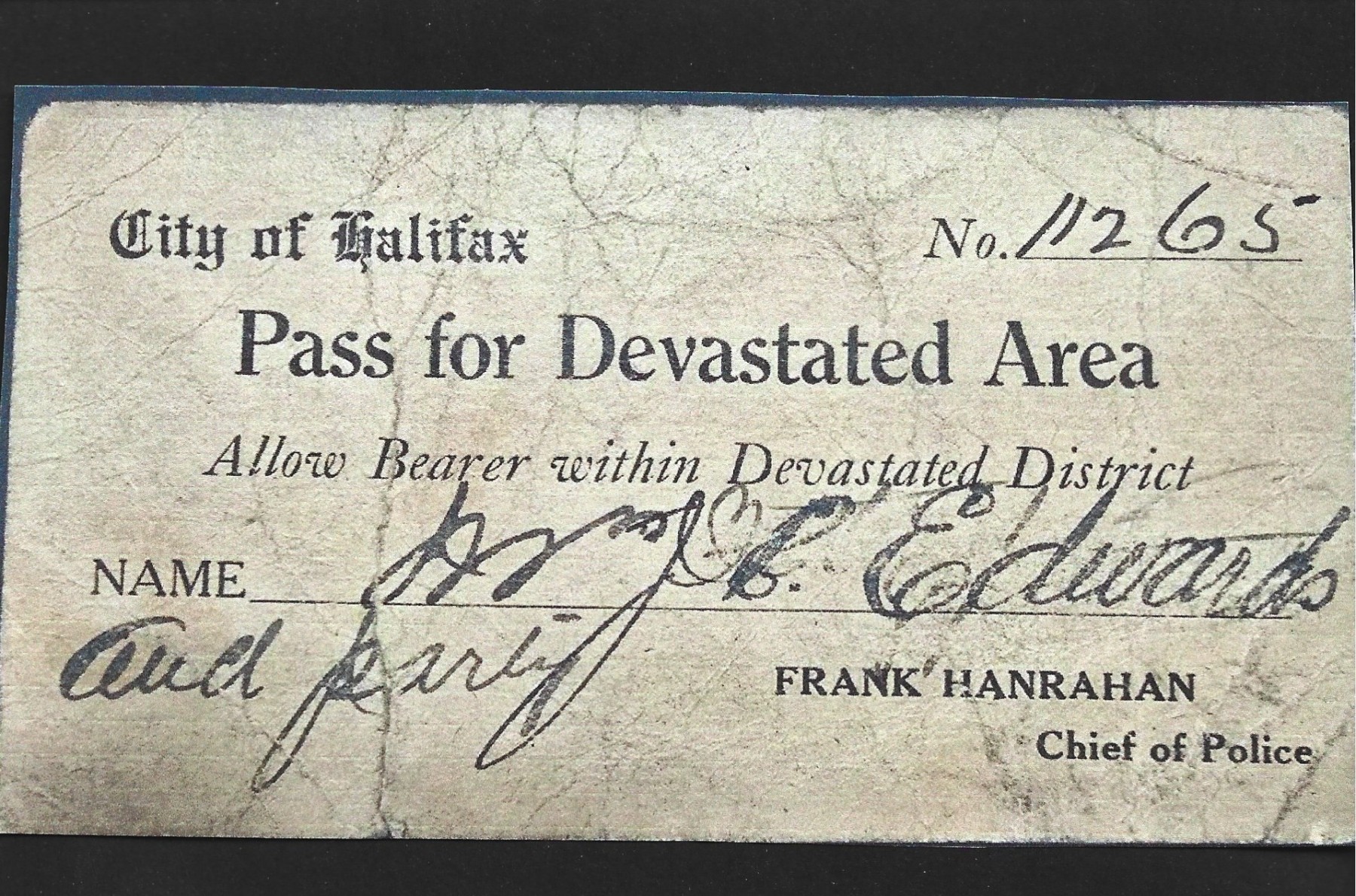
Strange sights were to be seen about No. 10 Train that morning. Col. Phinney recalls vividly the first case that came under his notice, was a boy suffering from three wounds. A rivet had been driven into his right eye, the top of it was showing plainly, a piece of iron, apparently plating from the Mont Blanc, had penetrated his chest and another had gone into his right thigh. They were large pieces of plating and driven in deep, but there was no effusion of blood. Col. Phinney examined the wound in his chest and it seemed to him that the edges were seared. The wounded boy was quite calm, talked rationally and said that nothing hurt him, but his injuries were so severe that they must have caused his death.
Another episode was the arrival at this point of several sailors, probably four or five, who had swan ashore from wrecked or disabled vessels in the harbour. One man was in his shirt and a pair of overalls, he had managed to save the ship’s papers in a large packet. After talking sensibly for a little while and saying that he thought the ‘old man’ (his captain) was lost, he collapsed and was put on board the train with other injured persons.
About noon, Col. Phinney made his way to Headquarters and reported what had been done. He was given general instructions to return whence he had come and continue his work. He went back to Richmond with a brother officer through the wreckage and passed the many corpses. Some of these were ‘mangled’, others had no mark of injury on them at all, but were quite nude except that their boots remained on their feet. These had been killed by
concussion. The same thing happens in modern warfare when large shells explode. Men may be stripped of their clothing and killed without any mark of violence appearing on them. There is a difference in the expression of those instantly killed compared to those in France. In France, the faces of dead soldiers wear a look of determination, teeth clenched, brows drawn. In the Explosion those wore a look of surprise, surprise not fear, the mouths were open and the eyes staring as if they were looking at they knew not what!
To return to Train No. 10, as yet none of the sufferers had received any attention beyond amateur first aid. The ‘rough bandaging’ unavoidable in such conditions was noticed in the hospitals at Truro, but skilled help was on the way. That morning, Major C.E.A. DeWitt, a doctor and the son of a doctor, residing in Wolfville, had been ordered in from Aldershot to Halifax to attend a conference in the city. He had taken the early train and was approaching the city when the Explosion occurred, but it was too far away to produce any special sound or disturbance noticeable by those on board. Not until the train reached Rockingham did Major DeWitt learn of the calamity in Halifax from Mr. Graham, the General Manager of the D.A.R., who was waiting at the station.
The D.A.R. Train was sent back to Windsor Junction, while Major DeWitt was rushed into Richmond on an engine. His own account runs: “I arrived there about 11 a.m. No. 10 Train was on the track with windows broken but no further damage. The condition of the track and surrounding was almost too horrible to describe. Men, women and children were lying on the ground on boards, broken beds, doors, or anything they could get and suffering untold agonies. Naturally the work was difficult, as I was the only medical officer in the district at the time. Fortunately, I had my hypodermic case and morphine was a great blessing to many that morning.” He had, he adds, one hundred and twelve surgical cases to attend to. Altogether there were two hundred and ten injured persons on the train.
His difficulties were many, but Conductor Gillespie had also his problem. He ‘filled the train full’, it was the obvious thing to do, but it only increased his difficulties. Then what to do with them? Here was a trainload of broken, bleeding humanity standing on the track on the outskirts of a stricken, burning city and it was impossible to obtain orders where to go or what disposal was to be made of the unexpected passengers. Gillespie had to decide the matter for himself, he sent the engine to the Roundhouse for a fresh supply of coal and water and then ran the train back as far as Rockingham because, as he says, he did not know where else to go. There he received the necessary authorization to return to Truro. The train left Rockingham at 1:27 p.m. and reached its destination at five minutes to four. Conductor Gillespie had proved equal to the responsibility so suddenly thrown upon him. Perhaps his chief satisfaction lay in the knowledge that he saved one women’s life, by bandaging her wounds so as to stop the hemorrhage. The doctor told him so on examining the
case. He also had the forethought to take down the name and addresses of all injured persons on board his train.
On the way to Truro, Major DeWitt was completely absorbed in his duties towards his trainload of patients. He did not know that at Windsor Junction another doctor and a trained nurse had got on the train and begun to work at the other end of the train. Only at Truro did he discover that these were his father, Dr. DeWitt senior and his sister. During the journey, three children died and Dr. DeWitt performed two successful operations which deserve to be remembered for the difficulties overcome and one more proof that necessity is the mother of invention. He removed two eyes with no better instruments than a forceps and a pair of scissors.
At Truro station the people were waiting for the sufferers with open arms. An hour sufficed to transfer them all from the train to the three hospitals they had improvised that very afternoon. Unfortunately, all the local doctors had been gathered up in the special train and been taken to Halifax. It was impossible for the three DeWitt’s to leave their charges and they ‘carried on’. Doctors came from the country about Truro to assist and Dr. Eaton, who had been left behind because he was too ill, got up from his sick-bed to minister to the suffering. Major DeWitt’s conduct came to the notice of Headquarters and he was officially reported as having performed ‘Major DeWitt worked night and day for five days till he was finally relieved, arriving home a physical wreck, with an infected hand. He should have immediately gone sick, but he struggled on with his work, narrowly escaping the loss of his arm. The ‘work’ referred to was his regular attentions to the soldiers in camp at Aldershot near Kentville.