Fairview Historical Society Articles Archives
The Halifax Protestant Orphanage
Also known as The Protestant Orphan’s Home
Home – Articles – Videos – eBooks & PDFs – Local Authors – Sponsors – Contact
Submitted By: Devonna Edwards
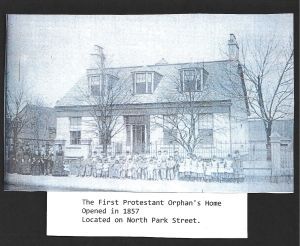
The first Home was located on North Park Street in a quaint little stone house. In 1857 it was founded by Rev. Robert Fitzgerald Uniacke, who was the rector of St. George’s Church and the fourth son of Attorney General Richard John Uniacke. Rev. Uniacke seen the need for a safe place of refuge for many children in the Halifax area, who were homeless and neglected. His photo is hanging on the wall of the old Home now called Veith House.
The Home’s first matron was Mrs. Rudolph and the first teacher was Miss Bell. The Head Matron had total control in the Home and her instructions were carried out to the extreme. Not all the children were orphans, some had parents that were not able to care for them due to illness or alcoholism. In 1886 the Home’s constitution and bylaws stated that “No parent, guardian or other person not officially connected with the institution shall interfere in any manner with the care or management of children while they remain in the Home.”
By the 1870s the Home was overcrowded and at that time due to lack of space, the schoolrooms had to be converted to a temporary hospital during an outbreak of measles. It was then decided that a larger facility was needed, the lot was too small to build a new structure, so in 1875 the Board found a new site in the Richmond District(North End).
Rose Hall
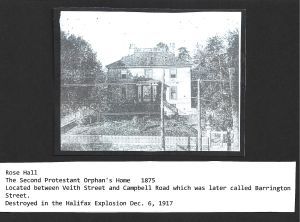
They purchased the residence and estate of William Jordan on property located between Veith Street and Campbell Road which was later renamed Barrington Street. The property contained twenty-eight lots, forty by 100 feet. The large residence was known as Rose Hall and was described as being fifty by fifty-two feet and having an excellent basement. The basement included a laundry, bathing room, wash room, wine cellar, pantry, coal room and a vegetable room. The first floor contained a kitchen, front and rear hall, and two pantries.
The second floor contained four bedrooms and two sitting rooms or dressing rooms. The attic consisted of three well furnished rooms. Also on the property was a coach house, wood house, hen house and stables. In earlier years, children were expected to do much of the work in orphanages. When the children reached their teen years they were placed on farms or in domestic service. There were forty-four children attending school at the Home in 1914, fifteen of these children did not live at the Home, but lived in the neighbourhood. The age of the children
attending the school ranged from four to twelve years old. By World War 1, in addition to the main house, the Home now included a school building and a hospital building.
The Halifax Explosion December 6, 1917
The Protestant Orphan’s Home was destroyed in the Halifax Explosion on Dec. 6, 1917. Twenty-six of the little children in the Home died along with the matron Miss Mary Knaut, her assistant Miss Ethel M. Melvin and the housemaid Lena Mahar. Some children survived the horrible event probably due to soldiers pulling them from the Home’s wreckage. According to the children that survived, the matron Miss Mary Knaut was last seen trying to gather the children together in the basement, because she thought it was an air raid and the basement was the best place to shelter.
The Home caught fire during the Explosion and burned down with a great loss of life. The Protestant Orphanage children and staff that died are buried in St. John’s Cemetery. The size of the plot is 20×27, has a small headstone and a monument which is hard to read but says, “IN MEMORY OF THE CHILDREN AND STAFF OF THE PROTESTANT ORPHANAGE KILLED IN THE HALIFAX EXPLOSION DECEMBER 6, 1917”. Next to this is another monument which stands in a garden box, it was placed there on the 100th anniversary of the Explosion to commemorate the children of the Protestant Orphanage who were killed in the Explosion.
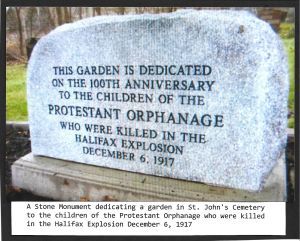
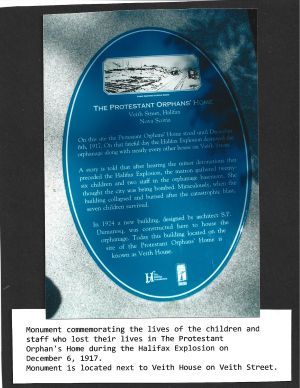
Rev. Robert F. Uniacke is also buried in St. John’s Cemetery, the founder of the orphanage. On his memorial stone Uniacke is called “The Children’s Friend”, he had no children of his own, but this may be why children of the Protestant Orphan’s Home lie near him in a sad little corner of the churchyard.
Temporary Orphanages
After the Explosion the Orphan’s Home moved into a building owned by the Nova Scotia Yacht Squadron, then it moved into the Brookfield House which was a large private home owned by Samuel Brookfield. The building was said to have a castle-like appearance and was described as quite impressive with two turrets and a veranda at two levels. The Home at that time was run by Superintendent Annie Fulton. Eleven school age children living at the Home attended Tower Road School for the year 1918-19. Later in 1919 they started their own school with thirty-three students taught by Christina M. Ross.
The New Orphanage on Veith Street – 1924
The Protestant Orphanage Home was rebuilt facing Veith Street, on the same site as the one that was destroyed in the Explosion. It opened in 1924. The building had two basements. In the lower basement there were swings, an indoor playroom for the use of the children in stormy weather and places of storage for fruit, firewood, etc. Just above the lower basement was the other basement consisting of the children’s and staff dining rooms, both exceedingly bright and amply lighted, the kitchen and the furnace room with a coal bin opening off the furnace room and another opening off the kitchen. There is also a laundry and store room.
On the floor above was a delightful cozy sewing room, with a large fireplace and a deep bay window and the school room, with a lovely view of the Halifax Harbour; the children’s reception room which is provided with a radio, a gramophone and library. There was a sun porch on the south side, a large wash room equipped with thoroughly modern facilities, a drinking fountain in the hall and roomy closets at the back. On the first floor were the two dormitories for the girls and the two rooms of the matron, the girls bathrooms, mop closets, the hospital ward and its bath and the room of the seamstress were also on this floor. All the rooms were spacious and lighted by ample windows running along two sides with each window being provided with wire screens. On the top floor were the dormitories for the boys and the room for the assistant matron is there as well as the boys bathrooms, the rooms of the cook and housemaid, closets for the children’s “Sunday Clothes”, a mop room and at the end as on the floor below, large closets for blankets and clothes. Throughout the house the floors were covered with battleship linoleum, of a cheerful grey. The building was provided with very fine and ample fire escapes, with strong metal doors, so that the little ones are completely safeguarded in case of fire. The Home also had a extensive yard for the children to play.
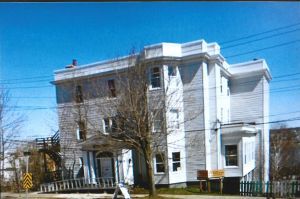
The new orphanage had the capacity of housing fifty children. Mrs. Elford was the matron and her assistant matron was Miss Eva Morash and they had a resident staff of five. Miss Hiltz was the seamstress, Mrs. McLean was the cook, Miss Chandler was the housemaid and Miss Gesner was the teacher.
The Quarantine Room also known as ‘The Horror Room’
A small room located on the left side upon entering the building was used as a quarantine room. All new children arriving at the orphanage had to spend two week in this room before having excess to the rest of the building. The staff wanted to prevent such conditions as lice, disease or other such contagious things from spreading to the other children in the Home. Upon entering the room, the door was locked behind them so they could not leave the room. There was no bathroom in the little room and the children had to use a bedpan. Isolated, frighten and alone, the prisoner only seen the staff when they came to feed or wash them and empty their bedpans. To make things worse there was no light in the room at night.
The children suffered terrible abuse at this ‘House of Pain’ and most were scarred for life at their treatment there. The book “Wounded Hearts” by Lois Legge, tell of the monstrosities afflicted on these poor little orphans.
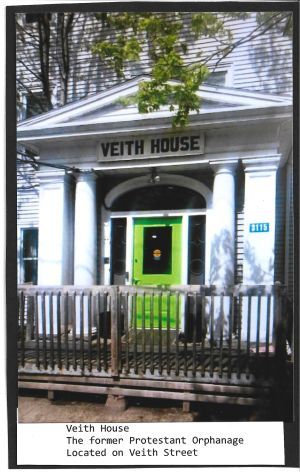
By the 1960 the Board of Governors of the Home decided that placing children in foster care, rather than in orphanages held a better home environment for the children. The Halifax Protestant Orphan’s Home closed in 1970 and a non-profit community centre known as Veith House now occupy the site.
Veith House
The Protestant Orphanage property was then transferred to the Halifax Children’s Foundation, to be used as the Veith House Community Centre and is still running today. The staff at the facility help people with financial problems, mental health issues and other services.